

 Google AI
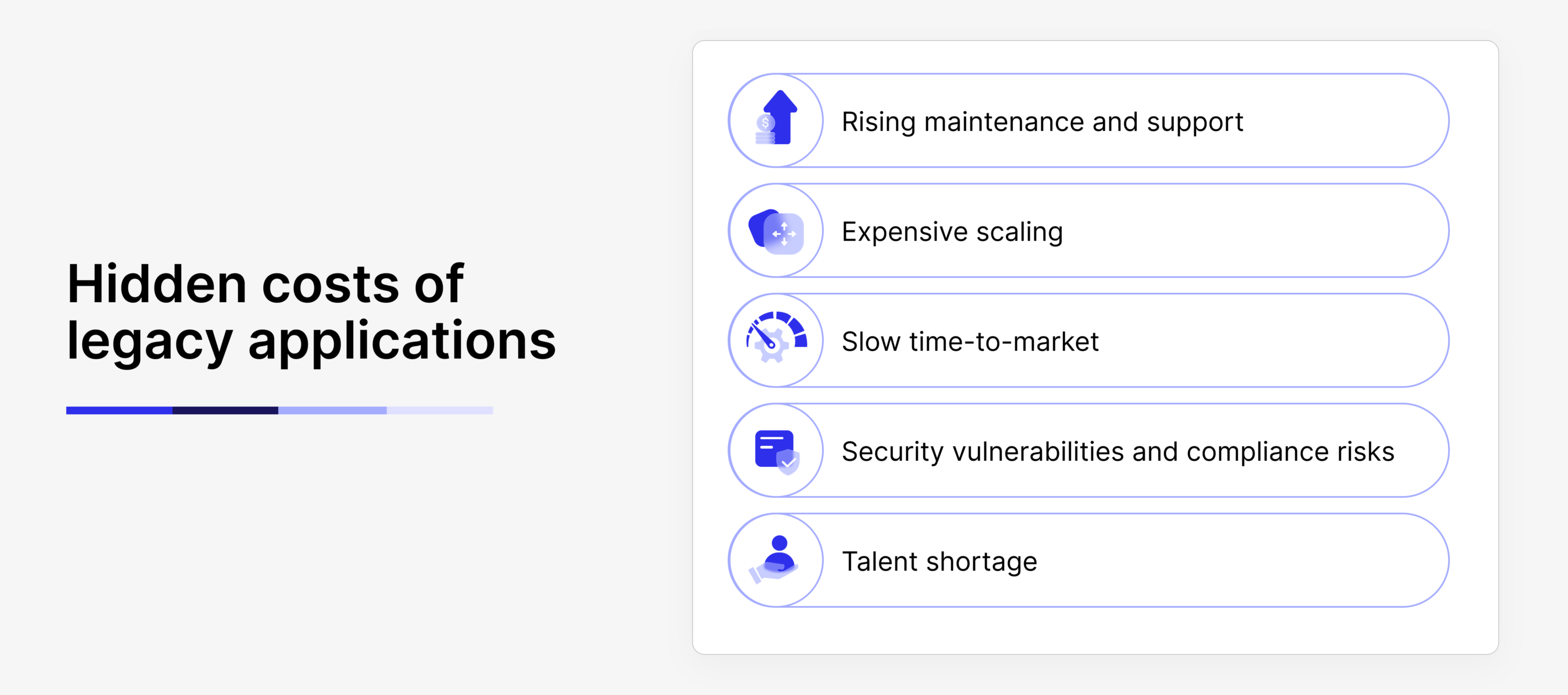
 Enterprise IT audits reveal a recurring pattern: organizations tightly control visible IT spend while quietly losing millions each year to inefficiencies embedded in legacy applications. These losses rarely appear as a single line item. Instead, they accumulate across maintenance overhead, security exposure, delivery delays, and missed revenue opportunities.
TL;DR: Legacy systems inflate operating costs, increase risk, and slow growth. Application modernization strategy has become a financial and business necessity.
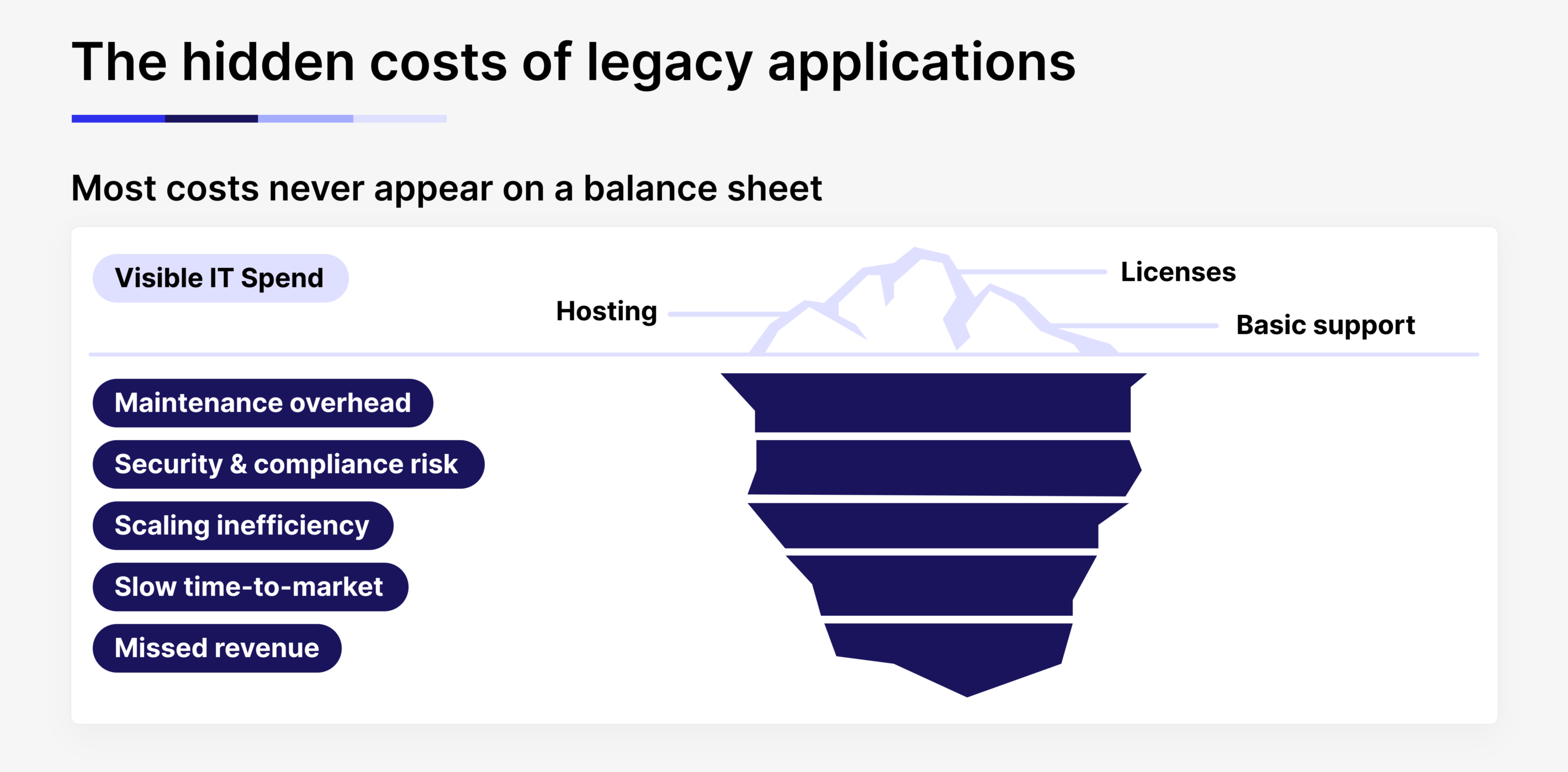
Legacy applications often require three to four times more maintenance effort than modern platforms, diverting engineering capacity away from innovation. What were once strategic investments are increasingly transformed into rigid cost centers, unable to support cloud scalability, AI adoption, or faster go-to-market cycles.
Gartner projects that by 2027, more than 70% of ERP initiatives will fail to fully deliver their business case, with one in four failing outright. This trend affects enterprises and mid-sized companies alike, underscoring the urgent need to modernize ERP systems, core platforms, and customer-facing applications. Now is the time to evaluate your current systems and take proactive steps to future-proof your technology landscape.
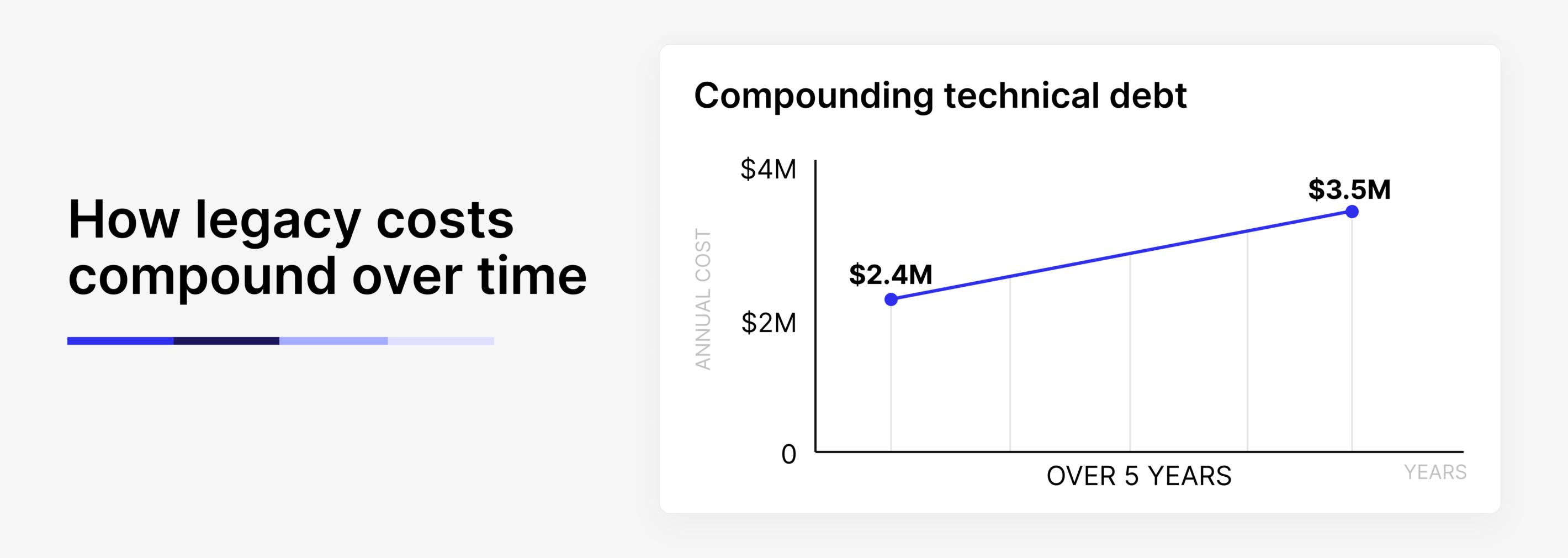
For business executives, the real danger lies in compounding inefficiency. Maintenance overhead, security and compliance gaps, integration friction, and opportunity cost escalate year over year. A system that costs $2.4M in its first year can exceed $3.5M annually within five years, driven by accelerating technical debt, without delivering additional business value.
In this article, we break down where these hidden costs originate, how to identify systems that are actively draining budget and velocity, and how modernization delivers measurable ROI without disrupting business continuity.
How modernization directly reduces costs
Modernization provides measurable ROI across infrastructure, maintenance, revenue, security, and talent.
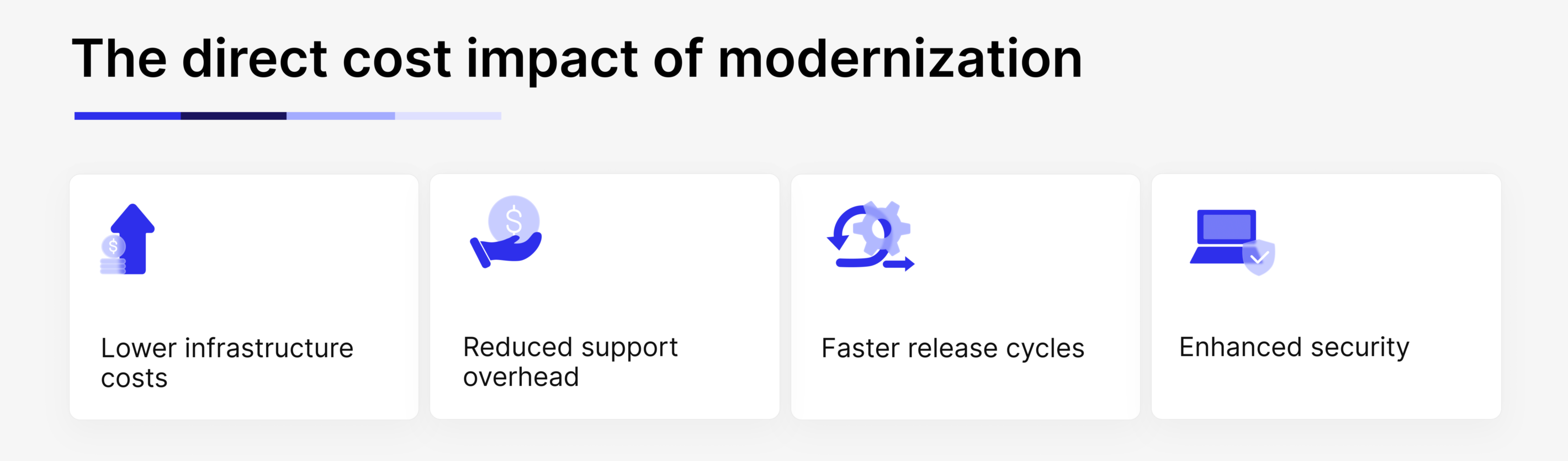
Lower infrastructure costs:
Cloud-native optimization eliminates over-provisioning and enables pay-as-you-go scaling. Modernized platforms typically reduce infrastructure costs by 30–35%. For example, Sombra helped a US eClinical technology company modernize its data platform, cutting infrastructure costs by 50% while enabling near real-time data syncing with delays of just 2 minutes.
Reduced support overhead:
Refactoring, automation, and retiring legacy components lower maintenance and operational costs by 20–40%. Modern systems reduce manual intervention and firefighting, freeing teams to focus on growth initiatives.
Faster release cycles:
Microservices and CI/CD pipelines accelerate development, shortening time-to-market and reducing opportunity costs. Organizations can respond quickly to customer needs and market changes.
Enhanced security:
Modern platforms integrate encryption, access control, and policy enforcement, lowering regulatory risk and protecting sensitive data.
Talent attraction and engineering velocity:
Modern architectures attract skilled engineers, reduce reliance on tribal knowledge, and improve onboarding, lowering hiring premiums and increasing productivity.
Why modernization pays off even during economic uncertainty
Economic uncertainty turns cost efficiency from a competitive advantage into a necessity. At the core of most large organizations lies aging digital infrastructure that slows innovation and inflates operational risk. In fact, 70% of the software powering Fortune 500 companies was developed more than 20 years ago. Modernizing these systems is complex, but the alternative is unpredictable budgets, reactive firefighting, and mounting technical debt.
Modern architecture solves these challenges. Cloud-native platforms, microservices, and automated pipelines create predictable costs by reducing manual interventions, maintenance overhead, and system downtime. Tools like agentic AI further accelerate modernization, analyzing workflows, updating infrastructure, and optimizing business processes with minimal human effort, improving efficiency and reducing resource intensity by 40–50%.
Beyond cost control, modernization delivers flexibility to adapt. Decoupled architectures, scalable cloud solutions, and automated processes allow businesses to respond rapidly to market shifts, regulatory changes, or emerging opportunities. Teams can deploy updates faster, experiment safely, and scale operations without being constrained by legacy limitations.
Modernization also strengthens operational resilience. Updated systems reduce downtime, enhance security, and integrate seamlessly with evolving technologies, ensuring organizations can maintain service continuity and regulatory compliance even during volatile periods.
In uncertain economic times, sticking with legacy systems is a gamble. Strategic application modernization transforms aging infrastructure into a predictable, flexible, and secure foundation.
How to measure “legacy pain” inside your organization
CTOs can quickly gauge modernization needs with this simple checklist:
- Percent of engineering capacity spent on maintenance
- MTTR / defect rate trends
- Infrastructure costs vs. user growth
- Security audit failures
- Integration lead time
- Developer satisfaction score
- Release cycles
- Team velocity
If 3 or more of these indicators apply, the software modernization ROI is immediate.
How Sombra help companies modernize without disruption
With more than a decade of experience in software engineering and consulting, we’ve worked with plenty of projects across industries, including highly regulated ones, to craft this custom approach:
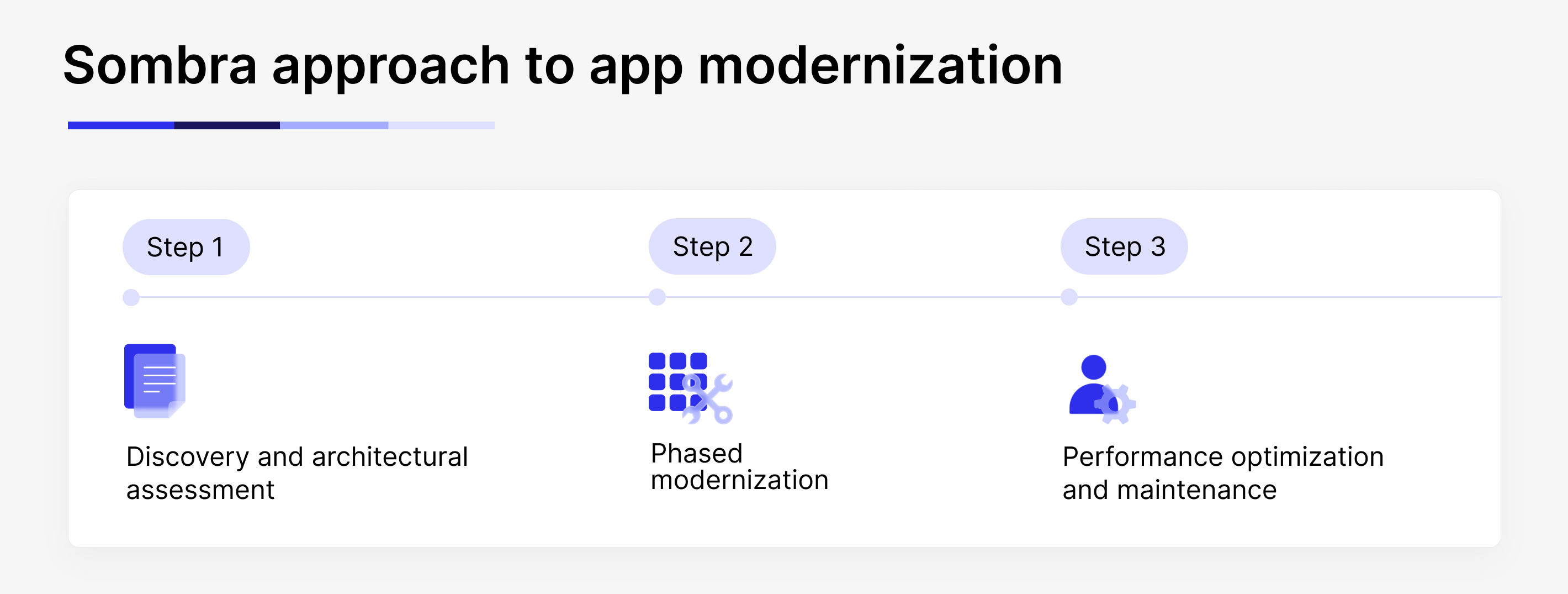
Our top experts: engineers, architects, and QAs work alongside your internal teams for maximum value.
The main business challenges we can help you with:
- Encountering long time-to-market for an app
- Struggling with time-consuming feature implementation or bug fixing
- Managing legacy systems and technical debt inefficiently
- Neglecting poor user experience
- Tackling performance issues and slow-working app
- Experiencing security vulnerabilities
- Worrying about high infrastructure costs
Contact us to get your legacy application assessment and detailed action plan to take action on hidden costs.