

 Google AI
 A good product or service, a powerful and user-friendly CRM, a team full of brilliant, enthusiastic people, established processes, and a positive P&L. What else should a business dream about in its daily life?
There is one thing that can still ruin this ideal world: the happiness of your customer, who has become far more sophisticated and selective than 15–20 years ago. And surprisingly, the reason is data. Customers now exchange their data for the expectation that interactions with brands will feel tailored and meaningful.
Based on Sombra’s experience working with Salesforce teams across various industries, this gap between available data and usable personalization is where many initiatives either succeed or stall.
Why AI-driven customer journeys are bigger than a trend
Let the numbers speak for themselves. Companies that deploy personalization strategically are seeing an average 10–15% increase in revenue, along with higher retention rates. AI-driven journeys take this further by enabling businesses to respond instantly to customer needs and behaviors, something that is impossible to achieve with manual methods.
On the other side, an AI-driven customer journey is also where the market is heading. We are moving toward a world where nearly 100% of customer interactions involve AI in some form. Leveraging AI is becoming the baseline for modern customer experience.

Businesses that adopt AI orchestration now position themselves to improve conversion, loyalty, and lifetime value, while those that delay risk falling behind both customer expectations and more AI-mature competitors.
The gap: data is rich, but personalization is poor
On paper, most organizations already “have the data.” In practice, what they usually have is data that is fragmented, delayed, or hard to trust. This is where many AI-powered journey initiatives quietly stall.
Across real-world Salesforce programs, three recurring gaps show up long before models or journeys become the problem:
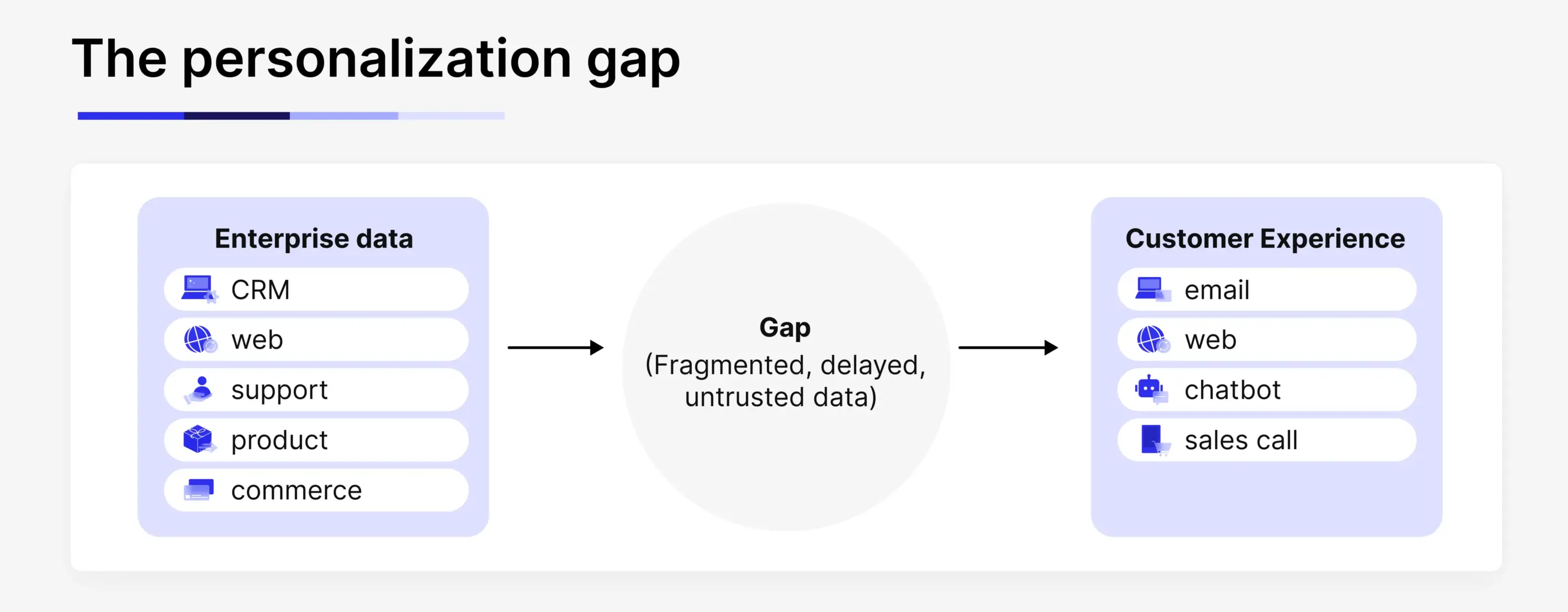
Accessible vs. Actionable data
Data often exists in reports, warehouses, or batch exports, but not as real-time signals that journeys and AI models can actually act on. A customer may browse a product or open a support case, but that event reaches Marketing Cloud or Sales Cloud hours later, when the moment of relevance has already passed.
Unified vs. Fragmented data
Identity resolution is rarely clean. The same customer appears as multiple leads, contacts, and commerce profiles. When AI is trained on conflicting records, recommendations become inconsistent and hard for teams to trust.
Insight vs. Execution data
Many teams build impressive dashboards, but those insights never make it into decision points. The organization can “see” churn risk or buying intent, yet the journey logic cannot act on it automatically.
This is why personalization often feels shallow. The issue is not the absence of data, but the absence of data that is wired into execution. Until signals can move reliably from source systems into journeys, next-best-action models, and human workflows, AI remains a layer of analysis rather than a driver of experience.
Here are some common patterns we see. A marketing team optimizes journeys while a service team manages sentiment in a separate system, and sales works from yet another view of the account. The customer experiences this as disjointed communication. The organization experiences it as “AI that works in theory but not in operation.”
Bridging this gap means treating data as a system (not just an asset to be collected): with ownership, latency targets, quality controls, and clear rules for how signals trigger actions across marketing, sales, and service.
The evolution of customer journeys in Salesforce
In Salesforce environments, customer journey management typically begins as a marketing automation initiative and gradually evolves into an operating model for the entire front office.
Early implementations typically focus on Marketing Cloud’s Journey Builder: triggers, branching logic, and multi-step flows designed around campaign goals. These systems work well when behavior is predictable and segments are stable. The challenge emerges as soon as real-world variability enters the picture – support cases, sales negotiations, delayed onboarding, or product usage patterns that do not fit predefined paths.
This is where many organizations hit a ceiling. Journeys become complex flowcharts that are expensive to maintain and brittle to change. Each new exception requires another rule, another branch, another dependency.
The shift toward intelligence-driven journey orchestration changes the design question entirely. Instead of asking, “What path should we build?” teams start asking, “What decision should be made at this moment?”
In practice, this means using AI to evaluate context in real time: recent activity, historical behavior, current sentiment, and business priorities. Rather than forcing customers through a scripted sequence, the system determines the next best interaction based on what is most likely to move the relationship forward at that point in time.
Organizations that make this transition often restructure their journey design process. Marketing defines goals and guardrails, data teams define the signals and models, and sales and service define when human intervention is required. The journey becomes a shared operational asset rather than a campaign artifact.
For example, this approach is reflected in Salesforce features such as Einstein, which can determine next-best actions or product recommendations dynamically within a journey.
Salesforce data cloud: Unified customer profiles
From Sombra’s experience delivering Salesforce and data modernization programs, the difference between fragmented data and a truly unified customer profile is often the difference between automation that looks good in a demo and orchestration that holds up in production. Across multiple enterprise implementations, our team has seen that investing early in Data Cloud architecture and governance dramatically improves the reliability of downstream AI models and journey logic.
If data is the fuel for personalization, Salesforce Data Cloud is the engine that makes it usable. Data Cloud (formerly Customer 360 Audiences/CDP) functions as real-time or near real-time customer data platform depending on the data source and ingestion method that unifies information from across the enterprise and beyond. It merges structured and unstructured data, batch and streaming inputs, from internal and third-party sources into a governed, usable layer. and streaming inputs, from internal and third-party sources into a governed, usable layer.
In practice, Data Cloud brings together behavioral data from websites, transactional records from commerce systems, CRM contacts and leads, product usage logs, and support tickets. These signals are stitched into a single, dynamic customer profile often referred to as the “Customer 360” profile.
Crucially, Data Cloud is not a passive repository. It is integrated into the Salesforce platform, so unified profiles can drive instant updates and triggers. For example, when a customer browses a product, that signal can update segments, trigger a relevant journey in Marketing Cloud, or prompt a sales action. By acting as the connected source of truth, Data Cloud provides the foundation on which AI can personalize experiences accurately and in real time.
Not all data is equal: Core categories
In delivery, “data-first” rarely means “collect more data.” It usually means deciding what data is allowed to make decisions.
Most Salesforce environments contain far more signals than teams can realistically operationalize. The challenge is selecting, standardizing, and governing the subset of data that will drive AI models and journey logic.
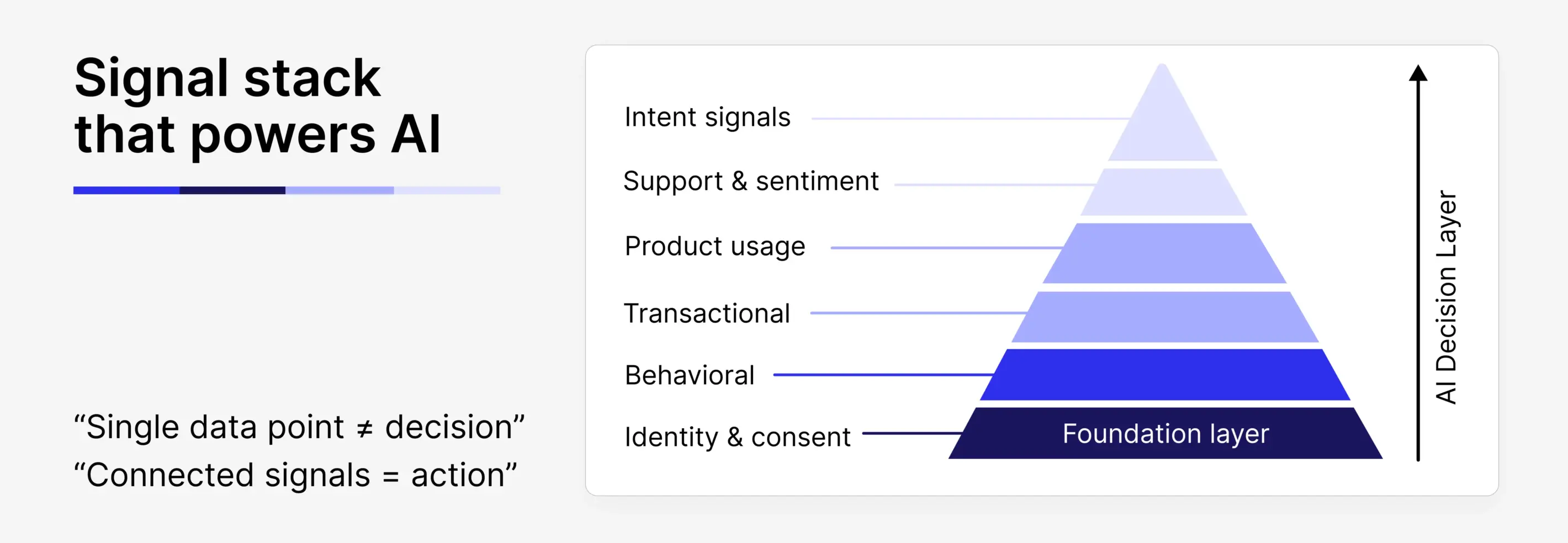
To personalize effectively at scale, organizations typically focus on a few core categories:
- Behavioral data: Website interactions, email engagement, mobile app usage, and content views that indicate interest and momentum.
- Transactional data: Purchases, subscriptions, renewals, and contract changes that define commercial value and lifecycle stage.
- Product usage data: Feature adoption and usage frequency that reveal success, expansion potential, or early churn risk.
- Support and sentiment data: Cases, chats, surveys, and resolution history that shape how and when a customer should be approached.
- Intent signals: Pricing page visits, form submissions, trial activity, and third-party data that indicate buying readiness.
The operational difference comes from how these signals are connected. A single data point rarely drives a meaningful decision. It is the combination that matters. For example, high product usage combined with repeated support cases often points to an expansion opportunity that requires human outreach, not an automated upsell email.
Governance becomes critical at this stage. Teams must define:
- Which fields are authoritative for identity, lifecycle stage, and consent
- How quickly events must propagate to downstream systems
- Who owns data quality when a model or journey produces a bad outcome
Without this, AI becomes difficult to trust internally. When a sales rep sees a recommendation that contradicts their account view, or a marketer sees a customer enter a journey they should have been excluded from, confidence in the system erodes quickly. Experience-driven implementations invest as much in data ownership and operating processes as they do in models and tooling.
How AI transforms customer journey design
Before AI, most customer journeys were designed in advance. Teams decide which segment gets which message, through which channel, and after how much time. The system executes those instructions at scale, but the logic itself is static.
With AI integrated, decisions are made closer to the moment of interaction. The system continuously evaluates context and dynamically determines the next best action. This shift adds a new layer of design: setting business intent, specifying constraints, and clarifying handoff points between automation and humans.
Predictive recommendations & personalization
AI analyzes past behaviors and similarities across users to predict what content or product will most interest a specific person. In Salesforce’s Marketing Cloud and Commerce tools, Einstein algorithms can recommend products (“Customers like you bought X”) or content pieces tailored to each user. These recommendations evolve as the AI learns more – if a customer’s browsing behavior shifts, the suggestions update in real time. This goes beyond rule-based personalization, uncovering patterns invisible to manual analysis.
Next-best-action/Offer engines
Traditionally, marketers might predefine a journey’s next step – e.g., send Offer A if the customer clicked an email, Offer B if not. AI-driven journey orchestration replaces these static rules with dynamic decisions. Salesforce Einstein can evaluate a multitude of factors (customer profile, current engagement, predicted conversion likelihood, etc.) and decide the optimal next action for each customer: whether it’s a discount, a product demo invite, a service call, or perhaps doing nothing at all. Leading organizations develop predictive next-best-action models that determine the right message or intervention, delivered through the right channel at the right moment. These AI decision engines operate continuously, refining their choices as new data streams come in.
AI-powered segments & dynamic content
Segmentation no longer has to rely on static attributes (like demographic or firmographic info). AI can create segments based on complex patterns in customer data – for example, an “at-risk churn” segment based on usage drops and support tickets, or a “high-growth potential” B2B account segment based on numerous intent signals. These segments can update in real time (entering or exiting as behavior changes). Similarly, dynamic content blocks in emails or webpages can be populated by AI on the fly, ensuring each customer sees content most relevant to them. For instance, the hero banner on a homepage might show different products to different users based on their data profile and predictive affinities.
AI-triggered events
AI can monitor sentiment and lifecycle changes to trigger the right journey at the right time. In Service Cloud, sentiment analysis might flag an unhappy customer from their support case notes – which could trigger a retention workflow or alert an account manager. In marketing, AI can detect if a customer moves into a new life stage (say, a change of address suggesting a relocation, or a small business graduating to mid-market) and then initiate a tailored nurture sequence. AI models can also react to external real-time behaviors – for example, if a customer is browsing a pricing page for an unusual amount of time, an AI-driven journey might immediately cue a chatbot or sales outreach, recognizing this behavior as a strong intent signal.
In sum, AI brings a layer of intelligent responsiveness throughout the customer journey. It treats the journey less as a predetermined path and more as a contextual conversation, where the next interaction is determined by the customer’s current context and predicted needs. The payoff is a smoother experience for the customer – they feel “known” and catered to – and higher efficiency for the business, which can automate decisions that marketers or sales reps used to make manually (and often slowly). AI doesn’t replace strategy or creativity; rather, it augments teams by handling the tactical personalization decisions instantaneously and at scale.
Use cases for AI-powered customer journeys in Salesforce
AI-powered customer journeys can be applied wherever tailored engagement matters – which is to say, virtually every industry and business model. Here are a few high-impact use cases.
B2B onboarding and nurturing
In B2B scenarios, onboarding a new client or user group is a critical journey. AI can monitor how (and if) new users are engaging with a product or service during the onboarding phase. If usage is low or certain setup steps are delayed, the system can automatically trigger helpful interventions – such as sending how-to content, scheduling a training webinar invite, or alerting a customer success manager to reach out. Conversely, highly engaged new users might be fast-tracked to advanced tips or even upsell pitches if the AI identifies them as power-users.
This ensures each account gets the right level of attention to become successful. Additionally, for account-based marketing (ABM) efforts, AI can help identify which prospects within a target account are showing buying signals (e.g., frequent website visits, content downloads) and then activate a personalized outreach journey via Salesforce Marketing Cloud Account Engagement (Pardot) tailored to that account’s context.
Renewal prediction and proactive retention
In subscription-based businesses (common in SaaS and many services), retaining customers is as important as acquiring them. AI models (such as Einstein Discovery in Salesforce) can analyze a host of factors – declining login frequency, lower usage of key features, support ticket volume, NPS survey dips, etc. – to predict which customers are at risk of churning.
With those predictions, Salesforce can automatically enroll at-risk customers into a retention journey. For example, the journey might include sending a “we’re here to help” message, offering a consultation to realign on value, or a special renewal incentive for those flagged as high risk. Sales or success teams can also get alerts to intervene personally.
On the flip side, AI can identify which accounts are primed for renewal and potentially receptive to an upsell, prompting targeted offers well before the renewal date.
Real-time personalization in B2C e-commerce
In B2C retail or consumer services, AI-driven journeys shine in real-time contexts. Think of a shopper browsing an online store: AI can instantly segment that shopper (new vs. returning, high-value vs. bargain-focused, product interest categories based on clicks).
Using Salesforce Marketing Cloud Personalization, the website can adapt content on the fly – showing a personalized home page banner, sorting products by relevance, or offering an AI-chosen incentive (free shipping for one shopper, a product bundle for another), most likely to convert that individual. If the shopper abandons a cart, AI can factor in their browsing history and purchase likelihood to decide whether to send a follow-up email, what product recommendations to include, and when to send it. These kinds of AI-driven micro-journeys happen continuously and individually, improving conversion rates and customer satisfaction.
Many brands also use AI to re-engage lapsed customers: for instance, detecting that a customer hasn’t purchased in six months and triggering a win-back campaign with content tailored to the products or categories that AI believes they’re still interested in.
End-to-end journeys across sales, marketing, and service
One of the ultimate promises of AI in Salesforce is connecting all customer-facing departments. Imagine a scenario: A customer interacts with a brand by downloading a whitepaper (marketing), then later contacts support about an issue (service), and also has an open proposal for an upgrade (sales).
Traditionally, these would be separate tracks, often with no knowledge of each other. In an AI-orchestrated journey, the Data Cloud unified profile ensures these dots connect. The customer’s support sentiment might affect the sales approach (AI could suggest postponing an upsell until the issue is resolved and customer sentiment improves). Or if the AI notes that the whitepaper topic they downloaded indicates interest in a certain product, it could prompt the sales rep with a next-best action to highlight that product’s value in the next call.
Post-service, the system might automatically send a satisfaction survey or helpful article, and if the sentiment comes back positive, seamlessly transition the customer into a cross-sell marketing journey for the upgrade.
These handoffs – marketing to sales to service and back – can be choreographed by AI agents and workflows (Salesforce’s upcoming Agentforce AI agents are an example) so that the customer experience feels like one continuous conversation with the brand. The organization benefits from higher conversion (since opportunities aren’t missed or fumbled) and the customer feels genuinely looked after rather than bouncing between silos.
The Salesforce stack for AI-driven journeys
To achieve the highest level of intelligence, each new customer journey requires using several components of the Salesforce platform in concert.
Salesforce has been infusing AI across its product stack – often under the Einstein brand – and when combined with its robust data and process automation tools, it provides a comprehensive toolkit for AI-powered experiences. Key elements include:
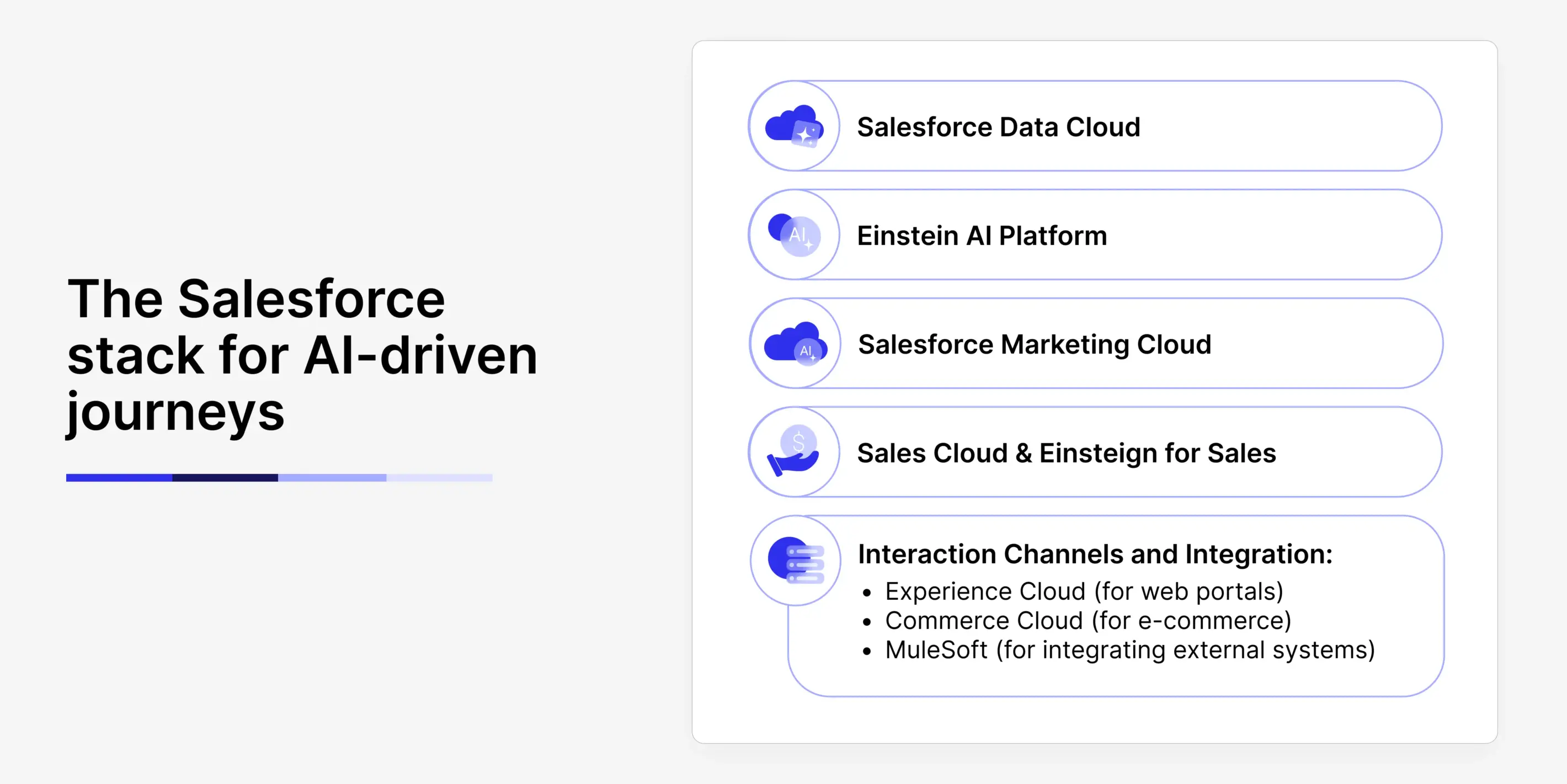
Salesforce Data Cloud
As discussed, this is the foundation that pools customer data from all sources (CRM, web, mobile, email, third-party, etc.) and keeps it updated in real time. Data Cloud gives you that unified profile and segments that all the other systems can use. It also includes tools for identity resolution (matching identities across systems), data harmonization, and calculated insights (like scores or aggregates), which are very useful for AI models.
Einstein AI Platform
Salesforce’s AI capabilities span predictive analytics (Einstein Prediction Builder, Einstein Discovery), machine learning models, and the newer generative AI offerings. Einstein Studio allows data science teams to bring their own machine learning models and deploy them within the Salesforce ecosystem (often using Data Cloud data).
The Einstein GPT and Einstein Copilot features, introduced in 2023-2024, embed generative AI into Salesforce apps – for example, to automatically generate email drafts, knowledge base articles, or code snippets, based on both user prompts and the company’s CRM data. In marketing and commerce, Einstein Copilot acts as a conversational assistant that can help build campaigns or create content dynamically, while being grounded in the brand’s voice and customer data.
On the predictive side, Einstein includes things like Einstein Engagement Scores (predicting which customers will open emails or convert), Einstein Frequency and Recency predictors, and Next Best Action frameworks. These AI features are the brains that analyze data and make recommendations or decisions within customer journeys.
Salesforce Marketing Cloud
This is the orchestration engine for designing and executing customer journeys. It is used mainly for marketing, but increasingly supports any multi-step engagement.
Journey Builder can take the segments and triggers from Data Cloud and Einstein and use them to enter customers into journeys. Within these journeys, Einstein can be invoked at decision points – e.g., an Einstein Email Recommendation content block, or branching a path based on a predictive score (high propensity vs low propensity customers).
Marketing Cloud also encompasses channels (Email Studio, Mobile Studio for SMS/push, Advertising Studio for ad audiences, etc.), which all plug into journeys. Dynamic content and personalization strings have traditionally allowed one-to-one customization; now AI is supercharging this by determining not just what to personalize but when and to whom automatically.
Sales Cloud & Einstein for sales
On the sales side, AI helps guide sales reps to prioritize and engage leads and opportunities. Einstein Lead Scoring and Opportunity Scoring are classic examples – these algorithms rank which leads or deals are most likely to convert so reps focus their energy efficiently.
There’s also Einstein Activity Capture which auto-logs emails and meetings, freeing reps from data entry (and ensuring CRM data stays rich). With Agentforce and Einstein Copilot, sales teams can even offload tasks to AI – like an SDR agent that drafts personalized outreach or a sales assistant that reminds a rep to follow up at optimal times.
Interaction channels and integration
Salesforce’s platform also includes Experience Cloud (for web portals), Commerce Cloud (for e-commerce), and MuleSoft (for integrating external systems). AI-driven journeys often need to span these surfaces – e.g., an AI might decide to show an offer on the website (Experience Cloud), send an email via Marketing Cloud, and create a task in Sales Cloud, all as part of one logical journey.
Having Salesforce’s clouds integrated through the Customer 360 platform means data and AI insights flow between them. For example, an AI recommendation generated in Commerce Cloud, such as the “recommended for you” products, can be utilized in a Marketing Cloud email to the same customer. Salesforce has been moving towards a unified platform (Einstein 1 Platform), where Data Cloud, AI, and automation features work seamlessly across the clouds.
This tech stack is complemented by governance tools (Einstein Trust Layer for AI ethics and compliance) to ensure the AI usage is responsible and in line with customer consent and privacy.
In essence, Salesforce provides the building blocks to create any AI-powered journeys: a central brain (Einstein AI), a unified memory (Data Cloud), and execution arms across marketing, sales, and service.
Businesses still need to assemble and tune these blocks to their needs – which is where expertise and strategy come in.
How to develop an AI-powered customer journey
From Sombra’s experience, implementing AI-driven customer journeys should be considered, first of all, a complex, phased transformation. Typically, we share the following roadmap with our clients to help them get started or scale their initiatives more effectively. So, let’s go step by step.
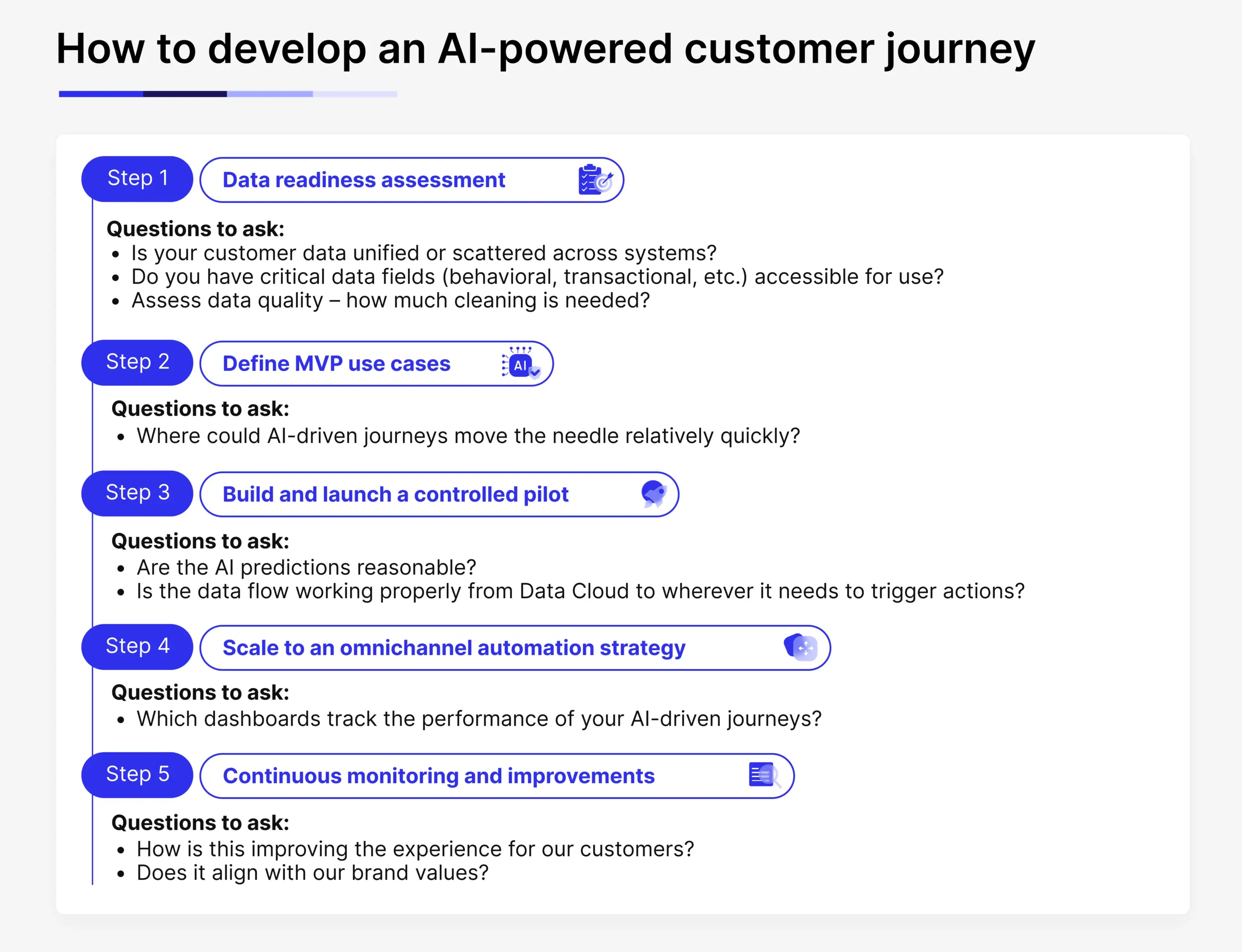
1. Data readiness assessment
Before layering on AI, take stock of your data. Is your customer data unified or scattered across systems? Do you have critical data fields, such as behavioral and transactional, accessible for use? Also, assess the data quality—how much cleaning is needed?
At this stage, many companies choose to implement Salesforce Data Cloud or another customer data platform if they haven’t already, to establish that single source of truth. Evaluate any gaps in data collection (for example, do you need to start capturing product usage events or web behaviors that you currently don’t?).
Ensure you have consent and privacy mechanisms in place, since personalization must respect customer data preferences. This step often involves stakeholders from IT, data engineering, and compliance along with business users, as you map out what data you have and what might be missing for your AI use cases.
2. Define MVP use cases
t’s tempting to envision AI improving everything at once, but the most successful rollouts start with a focused MVP. Identify a handful of high-impact use cases where AI-driven journeys could move the needle relatively quickly.
Good candidates often have a clear objective and available data – for example, “improve trial-to-paid conversion for product X,” or “reduce churn in segment Y,” or “increase cross-sell of product Z to existing customers.”
Engage both the technical team and the business owners of that metric. Define what success looks like and which KPIs you should follow, such as lift in conversion rate or reduction in churn percentage. Starting small allows you to prove value and learn without a huge upfront investment. Don’t try to transform everything at once – begin with focused use cases, build confidence, then expand systematically.
3. Build and launch a controlled pilot
With your MVP use case, design the AI-powered journey and associated models or logic. This might mean configuring Einstein features (like setting up an Einstein Next Best Action strategy or training a prediction model in Einstein Discovery) and building the journey in Journey Builder.
Keep the initial scope tight – maybe one or two channels and a limited audience segment – so you can monitor closely. It’s often wise to run A/B tests or hold-out groups to compare AI-driven approach vs. business-as-usual.
For instance, you might send an AI-personalized version of an onboarding sequence to half of new users while the other half gets the standard sequence, to measure the difference in outcomes.
During the pilot, closely watch the results and any operational issues. Are the AI predictions reasonable? Is the data flow working properly from Data Cloud to wherever it needs to trigger actions? Use this phase to gather learnings, both quantitative and qualitative. It’s normal to iterate – maybe the model needs retraining, or you discover you need an additional data attribute to improve accuracy. Also, ensure your teams are trained and comfortable with the new process; pilots are a great time for marketers or sales reps to get used to trusting AI recommendations.
4. Scale to an omnichannel automation strategy
After a successful pilot that demonstrates value, it’s time to broaden the scope. Scaling can happen in multiple dimensions: adding more customer segments, more journey types, and more channels/touchpoints under AI orchestration.
For instance, if you have used email and web personalization for a specific segment, you might next consider adding mobile app messaging or expanding your strategy to include another product line or geographic area. Ensure that your underlying architecture is robust; as you scale up your events and data volume, Salesforce Data Cloud and its integrations should be optimized to manage real-time data flows effectively.
Continue to enforce data governance as more data sources are connected. Many organizations at this stage create an internal “AI Center of Excellence” or similar cross-functional team to govern and guide the expansion of AI in customer journeys – ensuring consistency and sharing best practices. It’s also important to update your metrics and monitoring as you scale.
Define dashboards that track the performance of your AI-driven journeys (e.g., overall lift achieved, segments at risk, etc.) and put in place alerts for any anomalies (like an AI model drift causing weird recommendations). The scaling phase is iterative and ongoing – essentially a cycle of expanding, learning, and optimizing. Over time, AI-driven journey orchestration can become the default way you engage customers, with manual campaigns reserved only for when they’re truly needed.
5. Keep running
Throughout these steps, keep the focus on the customer experience. It’s easy to get excited about AI tech, but always ask: how is this improving the experience for our customers, and does it align with our brand values?
Early on, also involve stakeholders like legal and customer support to prep for any customer questions or issues (for example, if an AI recommendation is off-base, how do we handle that?). Implementing AI journeys is as much an organizational change as a technical one – marketers and sellers might need to adjust from executing tasks to overseeing AI outputs, which is a shift in mindset. Providing training and transparency into how the AI works (“why is it recommending this?”) can help build trust internally. 
Conclusion
AI-powered customer journeys become experience-driven when organizations stop treating them as campaigns and start treating them as part of how the business operates.
Salesforce provides the platform: unified data through Data Cloud, embedded intelligence through Einstein, and orchestration across marketing, sales, and service. The differentiator is how teams design decision ownership, data governance, and the balance between automation and human judgment.
Organizations that succeed tend to focus less on how advanced their models are and more on how reliably their systems create the right action at the right moment. Over time, this shifts AI from an optimization layer into an operating capability – one that turns customer data into consistent, trusted, and meaningful experiences rather than isolated moments of personalization.
At Sombra, we see AI-powered customer journeys succeed when technology, data discipline, and operational ownership come together. Our teams work alongside marketing, sales, IT, and data stakeholders to ensure that Salesforce AI capabilities translate into measurable outcomes and good ROI.
The most effective implementations balance ambition with discipline. Organizations that start with focused use cases, invest in data quality and governance, and scale systematically are better positioned to turn AI into a long-term capability rather than a short-term experiment.