

 Google AI
 Download the Enterprise AI Deployment Guide
AI is no longer an experiment. It is an infrastructure decision
The recent MIT NANDA initiative report shows that nearly 95% of enterprise AI pilot initiatives fail to generate meaningful financial impact, while only about 5% deliver measurable value. The difference is rarely the model itself — it is the implementation strategy behind it.
By 2026, enterprise leaders must choose how AI will operate inside their business: as a subscription, a core internal capability, or a combination of both. The wrong choice locks capital into the wrong cost structure, limits control over proprietary data, and slows strategic execution.

Forbes Research: Senior Leaders Crowd Out IT On AI Strategy
This guide provides a practical decision framework to align your AI deployment model with revenue goals, regulatory exposure, and long-term competitive positioning.
Three AI Deployment Models
Each model comes with distinct use cases and risk considerations that should be evaluated from the outset.
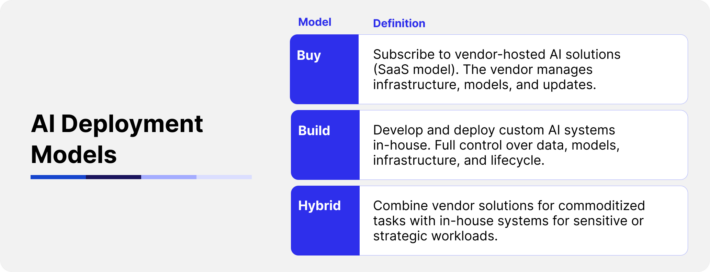
Buy involves adopting vendor-hosted AI solutions. It is best suited for standardized use cases that require rapid deployment and predictable operating costs. The primary risk is long-term dependency and increasing usage-based expenses as scale grows.
Build involves developing and operating AI systems in-house. It is appropriate when AI drives competitive differentiation or requires strict regulatory oversight. The tradeoff is significant upfront investment and operational complexity.
Hybrid combines vendor solutions for commoditized tasks with internal systems for strategic workloads. It offers flexibility and control, but requires strong governance and architectural discipline.
AI Models’ Cost Structure
Each deployment model follows a different financial trajectory:
Buy: Low upfront investment with recurring subscription costs tied to usage (API calls, seats, licenses).
Build: Significant initial investment in engineering, infrastructure, and data preparation, with the potential for lower marginal costs at scale.
Hybrid: Moderate initial investment with costs distributed between vendor subscriptions and internal infrastructure.
The guide provides break-even logic to help you determine when vendor pricing may exceed the cost of building internally — and how that affects 2–3 year financial planning. This is not about minimizing cost. It is about aligning cost structure with expected scale and long-term strategy.
Decision Criteria & The 3-Factor Rule
AI deployment decisions should not be based on preference. They should be based on structural indicators.
Assess your organization against six key factors:
- Proprietary data advantage
- Latency and performance requirements
- IP strategy
- Regulatory exposure
- Cost at scale
- Lifecycle control
The 3-Factor Rule: If three or more of these factors apply, building in-house or adopting a hybrid approach is typically the right path. If fewer than three apply, buying with strong governance is usually the more efficient option.
The guide includes a clear decision matrix that turns this discussion into an objective executive-level threshold test.
Pre-Implementation Checklist
Choosing the right model is only the first step. Before committing budget, confirm readiness across five critical areas:
- Data foundation (quality, ownership, governance)
- Technical requirements (SLAs, infrastructure capacity, integrations)
- Strategic alignment (business impact prioritization, IP clarity)
- Organizational readiness (AI capability, cross-functional alignment)
- Financial modeling (3-year TCO and break-even analysis)
Use this checklist as a board-level validation tool. It helps prevent stalled pilots, costly migrations, and reactive compliance corrections.
Pitfalls to Avoid
Even experienced teams fall into predictable traps:
- Prioritizing speed over long-term strategic alignment
- Underestimating regulatory and compliance complexity
- Treating proprietary data as operational input instead of a strategic asset
- Applying prototype economics to enterprise-scale production
The guide helps you identify these risks early — before they impact capital allocation, scalability, or competitive positioning.