

 ChatGPT
  Perplexity
  Grok
Grok  Google AI
 For many mid-sized wealth and asset management firms, the pressure for modernization and AI adoption no longer comes from a single source. It builds gradually, through board conversations, client expectations, regulatory scrutiny, and competitive signals that are hard to ignore.
Leadership teams hear the same messages repeatedly: artificial intelligence is reshaping financial services, real-time data is becoming a baseline expectation rather than a differentiator, and operational models built on fragmented systems will struggle to scale. But doing too much too soon can lead to disappointment and lost resources.
This article examines how wealth and asset management firms can integrate AI, data platforms, and modern infrastructure in a controlled, business-led manner, without disrupting advisor workflows or operations.
The Context: When Technology Moves Faster Than the Organization
When it comes to digital transformation and AI adoption in wealth and asset management, there is a growing sense that postponing action now carries tangible risk. And these fears are not baseless — AI adoption can indeed be transformative for asset managers.
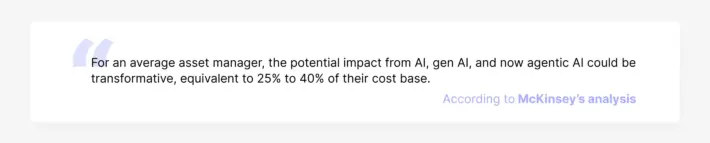
According to McKinsey’s analysis, “for an average asset manager, the potential impact from AI, gen AI, and now agentic AI could be transformative, equivalent to 25% to 40% of their cost base.”
But at the same time, urgency has not been translated into clarity. The challenge is not a lack of ideas. On the contrary, there are too many options on the table. Some stakeholders advocate for building proprietary AI capabilities to gain a competitive edge. Others argue for replacing large portions of the existing technology stack to “start fresh.”

Wealth and asset management firms understand what needs to improve but lack a structured approach to determine where to invest first, how much change the business could absorb, and how to avoid locking itself into decisions that would be difficult to reverse.
Why AI Adoption Creates Complexity in Wealth Management
Across leadership, there was broad alignment on the outcomes they wanted to achieve. They needed:
- Better client segmentation to support advisors and growth strategies.
- Faster internal analysis to reduce dependency on manual reporting.
- Stronger compliance controls that scale with regulatory complexity.
- Real-time visibility into operational and risk exposure.
What they lacked was a practical path forward.
Every discussion eventually stalled around the same uncertainty. Which tools would actually help? How much modernization was enough? And how could they move forward without destabilizing core operations?
The challenge was not a lack of ambition or awareness. It was the absence of a structured way to connect business priorities with technology decisions. Without that connection, innovation felt risky rather than enabling.
Many wealth and asset management firms approach modernization as a large, all-encompassing initiative. New platforms, new data strategies, and new operating models are often launched simultaneously. In theory, this promises coherence. In practice, it often introduces fragility.
Wealth management environments are typically shaped by years of incremental growth. Core systems are deeply embedded in daily operations. Data flows have evolved organically. Teams rely on workarounds that may not be documented but are essential for continuity.
Replacing everything at once creates operational risk, strains internal teams, and increases dependency on external vendors. More importantly, it often delays value realization. Firms invest heavily before seeing tangible improvements in decision-making or efficiency.
A Smarter Way Forward: Layer, Test, and Scale with Intent
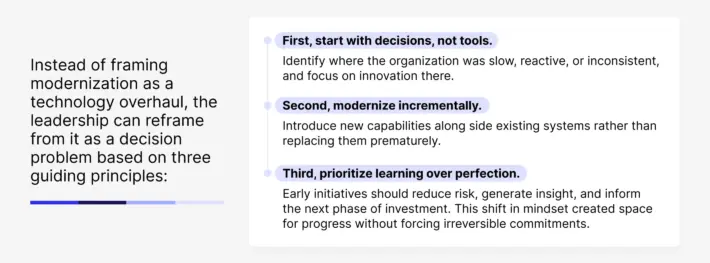
Three Ways Wealth and Asset Management Firms Can Modernize with Confidence
Let’s analyze a practical approach to modernization using our client’s story of AI adoption and technology upgrade.
Applying AI Where It Created Measurable Value
Rather than pursuing AI as a standalone capability, the firm treated it as an enabler for specific operational decisions.
Leadership worked with operations, compliance, and advisory teams to identify areas where human effort was high, but outcomes were inconsistent. Several use cases stood out:
- Client onboarding reviews varied significantly in duration and quality.
- Certain fund inflows were reviewed manually despite predictable patterns.
- Compliance teams spent disproportionate time on low-risk cases.
Instead of deploying a broad AI platform, the firm piloted targeted models integrated into existing workflows. Risk-based scoring helped prioritize onboarding cases that required deeper review. Pattern detection highlighted unusual investment behavior earlier in the process. Language analysis supported the summarization of investor communications for advisors and compliance teams.
These initiatives did not replace decision-makers. They reduced noise and focused attention on where it mattered most. As a result, decisions became faster and more consistent without increasing operational risk.
Modernizing Legacy Systems Without Breaking Operations
The firm relied on several long-standing systems; some homegrown and others heavily customized. These systems were not ideal, but they were reliable and deeply embedded in daily work.
A wholesale replacement would have disrupted operations and required extensive retraining. Instead, the firm adopted a modular modernization strategy.
Key steps included:
- Introducing service layers around legacy systems to expose functionality without rewriting core logic
- Shifting reporting from spreadsheet-based workflows to centralized dashboards
- Replacing rigid document-driven processes with API-enabled interactions
- Gradually moving selected workloads to scalable, cloud-based infrastructure
This approach preserves operational stability while improving flexibility. It also allowed modernization efforts to align with business priorities rather than vendor roadmaps.
The Hidden Cost of Fragmented Data and Infrastructure
As organizations advanced their initial AI pilots, a critical challenge quickly emerged: data quality and accessibility. According to a recent Accenture survey, 32% of respondents identified lack of trust in data as the top obstacle to adopting Responsible AI.
Client data existed across multiple systems with inconsistent formats; compliance information lacked a single source of truth, and operational metrics were often outdated by the time they reached decision-makers. Before expanding AI use, the firm invested in foundational data engineering.
They established pipelines to synchronize and standardize data across systems. Governance rules were introduced to reduce duplication and enforce consistency. Core platforms such as CRM, KYC, and fund administration were connected to enable near real-time reporting.
The impact was immediate. Leadership gained timely insight into operational exposure. Advisors accessed up-to-date client context. Compliance teams reduced manual reconciliation. Data became an asset rather than a bottleneck.
Moving Beyond the “AI Magic Pill” Narrative
Leadership discussions often returned to skepticism toward AI as a universal solution. Although many firms had previously experimented with pilots, these attempts often failed to scale or provide lasting value.
The firm realized that AI could not compensate for fragmented systems or poorly structured data. Additionally, organizational ambiguity around ownership and accountability remained unresolved by the technology.
Instead of positioning AI as the center of transformation, they treated it as one component of a broader operating framework. In some cases, traditional automation or workflow redesign delivers better results than machine learning.
This pragmatic stance reduced risk and aligned innovation with business reality.
Scaling Without Adding Complexity
One of the firm’s strategic goals was growth without proportional increases in headcounts. Achieving this required better prioritization of human effort.
- Advisors needed support in identifying high-impact client interactions.
- Operations teams needed visibility into workload distribution and bottlenecks.
- Compliance needed mechanisms to focus on legal expertise where it added the most value.
Targeted AI and improved data integration enabled these shifts. Anomaly detection reduced manual review. Prioritization logic directed attention to exceptions rather than routine cases. Operational transparency improved coordination across teams.
The result was not just efficiency, but resilience. The firm became better equipped to absorb growth without increasing fragility.
Where Sombra Comes In
Sombra works with financial services firms that want to modernize deliberately rather than reactively. The focus is not on deploying the latest technology, but on building systems that support long-term decision-making and scalability.
For this firm, Sombra’s role included:
- Assessing where AI and advanced analytics could create measurable business value
- Designing low-risk pilots aligned with existing workflows
- Building integration layers around legacy systems
- Engineering reliable data pipelines to support real-time insight
- Helping leadership distinguish between problems that require AI and those better solved through automation or process change
The engagement was structured as a long-term partnership rather than a one-off implementation. Each initiative informed the next, creating momentum without sacrificing control.
A Foundation for What Comes Next
This approach also created a foundation for future innovation. With cleaner data, integrated systems, and modular infrastructure, the firm positioned itself to explore more advanced capabilities over time.
Predictive analytics, advanced client segmentation, and system-level anomaly detection became realistic options rather than theoretical aspirations. Importantly, leadership understood how these capabilities would integrate into the existing operating model. Innovation became cumulative rather than disruptive.
Final Thought: Intelligent Modernization Is a Leadership Discipline
AI adoption in wealth management is no longer optional. But neither is discipline. Wealth management firms that rush into AI or large-scale transformation without addressing data readiness and system integration often create new risks while trying to solve old ones.
The firms that succeed are those that modernize intentionally. They align technology investments with decision-making needs, build incrementally, and treat data as infrastructure rather than output.
At Sombra, we help financial services organizations navigate this path. We work at the intersection of strategy, engineering, and operations to ensure modernization accelerates the business rather than destabilizing it. After all, innovation should increase confidence, not add complexity.