

 Google AI
 Tech talent shortage is today’s reality. According to an MIT Technology Review Insights survey, 64% of global tech leaders struggle to assemble a software development team because applicants lack relevant skills.
56% of respondents are also concerned about an overall tech talent shortage for IT department structure and roles. Deloitte’s 2022 Global Outsourcing Survey corroborates this: 50% of executives consider talent acquisition a top internal challenge.
If you’re ready to outsource software development, you need the right software development team to work on your project. As a software development company with a decade of experience, we at Sombra would like to share everything you should know about the software development team structure, from factors and types to roles and best practices.
3 key factors that impact the software development team structure
Before we dive into how to build a software development team, let’s acknowledge that there is no one-size-fits-all software development team structure solution. Which software development team composition will work best for you depends on your project’s three aspects: product itself, deadline, and budget.
Product type and complexity
Different types of software development projects require different software development teams.
A simple eCommerce mobile app will require a lean development team structure. The mobile app development team structure will consist of a product owner, project manager, business analyst, UI/UX designer, mobile developer(s), and QA specialist(s).
Simple web development will require one small team, too.
Complex projects like AR/VR mobile app development will require specialists with a narrow skill set. They’re also likely to require multiple software development teams.
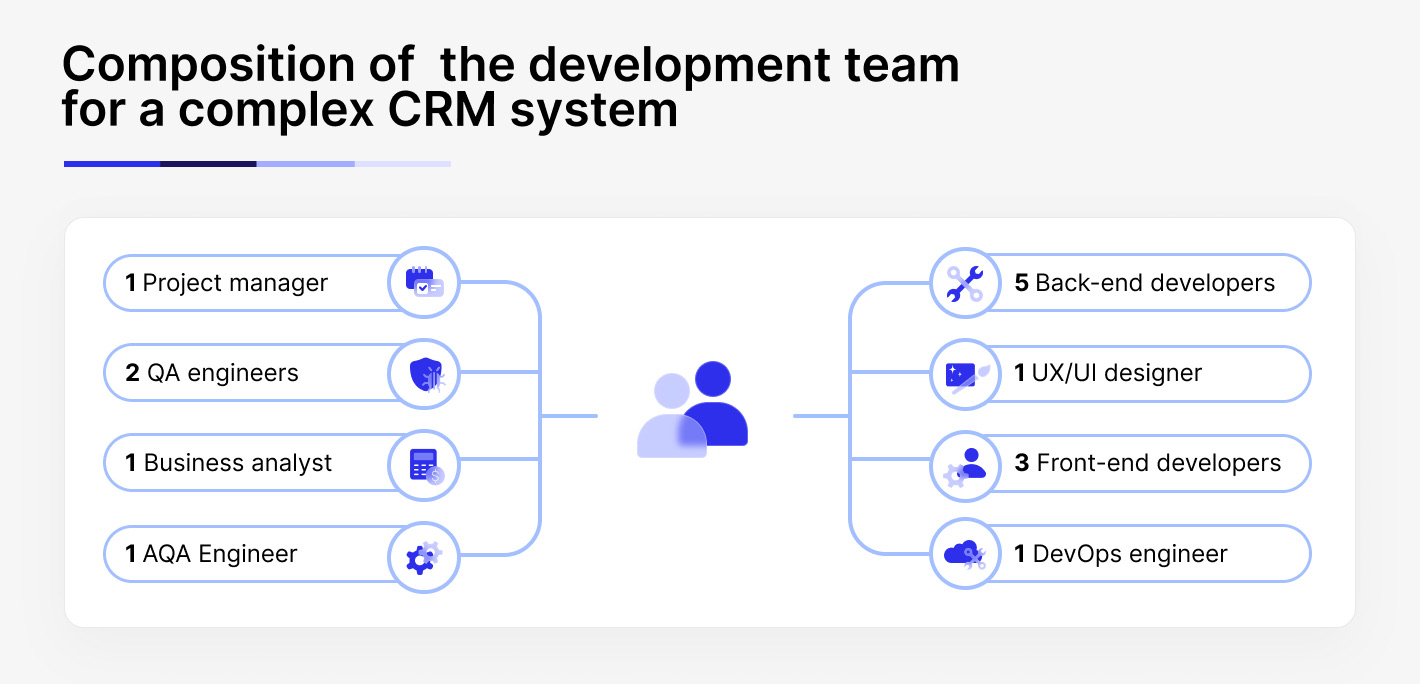
Composition of the development team for a complex CRM system
Deadline
Having the correct size of your software engineering team structure influences software development project delivery time.
You can speed up development by hiring more software developers and/or QA specialists if, for example, you need to launch your product ahead of the competition.
Budget
The size of the software development team determines the project budget as explained in our guide. The larger your software development structure is, the more you’ll have to pay to have your product developed.
You can reduce costs by outsourcing instead of downsizing the software team. Outsourcing to more affordable destinations can help you save between 40% and 70% in costs, according to Accelerance.
For example, developing an MVP in the United States (where hourly rates are between $100 and $150) can cost:
$100-150 per hour x 5 engineers x 480 working hours = $240,000-$360,000
In Ukraine, the same project would cost you:
$25-45 per hour x 5 engineers x 480 working hours = $60,000-$108,000
3 common types of development team structures
To enable effective software development, you need to choose the most suitable among three software development team structures: generalist, specialist, and hybrid. Let’s break down each software engineering team structure.

Types of development team structures
Generalist team structure
Under the generalist team structure in software engineering, team members can tackle various tasks across multiple areas of expertise. Unlike specialist software development teams, generalist team roles aren’t confined to a single area of expertise, enabling a more holistic approach to development.
The generalist software development team structure is suitable for mid-sized projects where flexibility is key. Generalist teams are also a good match for an agile organizational structure.
Specialist team structure
Under the specialist software development organizational structure, every team member specializes in their narrow area of expertise. The development team roles aren’t interchangeable. On the other hand, such a software development org chart ensures every task is tackled by an expert in the field.
This software development team structure is suitable for complex projects that require specific skill sets. A specialist product development team ensures development efficiency and product quality. However, it tends to be less flexible and more expensive than a generalist team.
Hybrid team structure
The hybrid approach is a way to gain the best of both worlds: the generalist approach’s flexibility and holistic product understanding and the specialist’s narrow expertise that powers efficiency and quality.
Under the hybrid software development team structure, generalist developers work on the project as a whole. Specialist development team members apply their expertise to narrow, complex tasks.
This software team structure allows you to combine efficiency and quality with flexibility, making it suitable for large-scale projects with tight deadlines. However, this team structure requires adaptable project management and can be more expensive and time-consuming.
Looking for a generalist, specialist, or hybrid team to tackle your project? Contact us to hire Sombra’s software development team structured to meet your project’s unique needs.
Agile vs. traditional methodology: what are the benefits?
The agile methodology is a different approach to the software development process. The agile software development project is broken down into iterations (i.e., sprints), at the end of which an agile development team delivers a working product. Agile requires cross-functional teams and close collaboration.
Traditional software development, or the waterfall approach, means software engineering teams sequentially develop the product. Development is a linear process where requirements are fixed at the planning stage and are hard to change once development begins. A traditional software engineering organizational structure is structured and involves top-down management.
Choosing between traditional and agile teams means choosing between waterfall and agile methodologies.
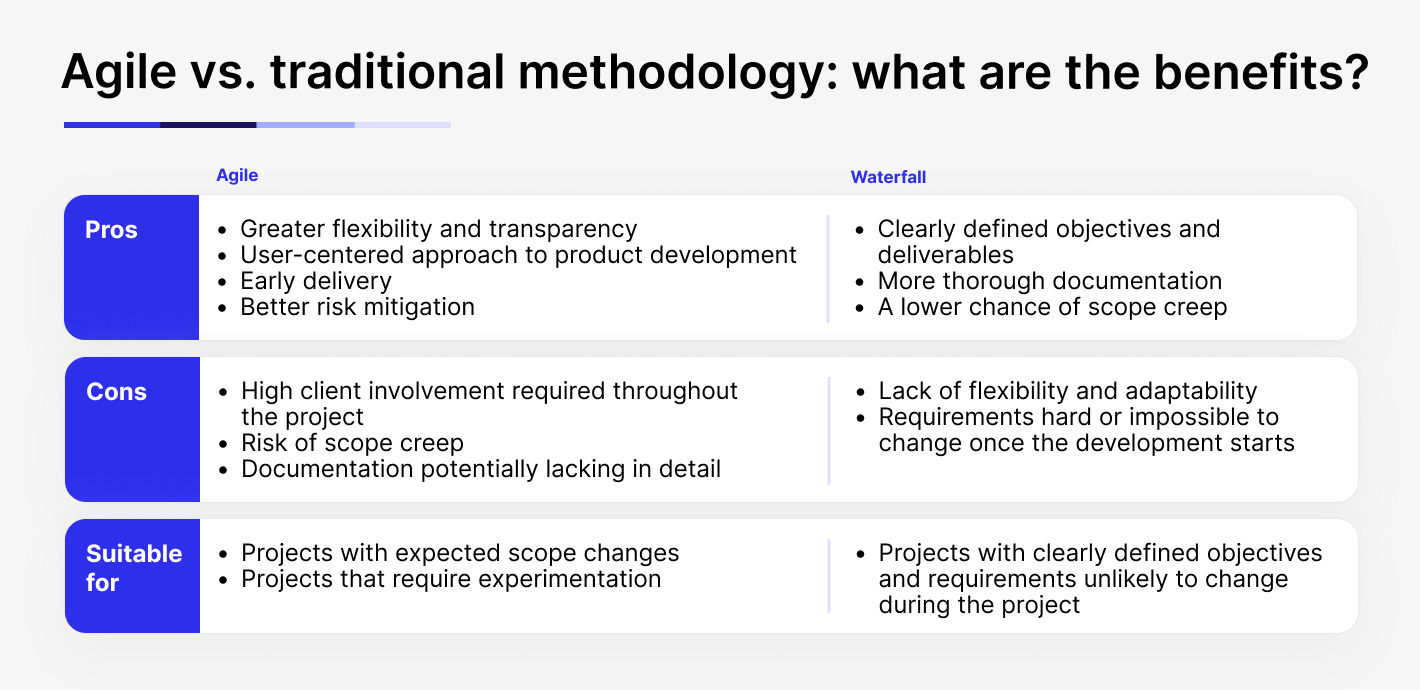
Waterfall vs agile methodology
As a result of differences in methodology, a development team in agile:
- Is cross-functional and small (up to nine people in the structure of software team)
- Focuses on one project at a time
- Involves every team member in the project’s success
Under the traditional methodology, the soft dev team:
- Involves top-down management in the software company organizational structure
- May be involved in several projects at the same time
- Is structured with distinct, rigid roles in software development
- Can be of any size
Agile team structure: roles and responsibilities
You’ll need an agile team if you opt for agile development in your software project. Here’s a common agile software development team structure, with eight agile development team roles and their responsibilities.
Product owner
One of the key roles in an agile team, a product owner is in charge of defining the product vision and evolution and ensuring the final product meets user expectations. They’re usually chosen by the client within the company, not by the software development organization.
The product owner’s responsibilities include:
- Finding the equilibrium between business requirements and market trends
- Defining business strategy together with the product team
- Ensuring the product vision corresponds to user needs
- Managing the product backlog
A product owner doesn’t play exactly the same role as a product manager. Product owners oversee product development from a more tactical standpoint than product managers. However, a product manager can subsume the responsibilities of a product owner.
Scrum master
The scrum master is one of the hallmark agile team roles and responsibilities that don’t exist in a traditional team structure. However, a scrum master is part of a development team in scrum, a lightweight agile framework.
During a development project, a scrum master:
- Conducts daily standups for the scrum team
- Facilitates iteration/sprint planning meetings
- Conducts sprint reviews and retrospectives
- Serves as the administrator of the scrum board
- Helps the soft dev team to eliminate blockers and busy work
While scrum masters and project managers seem to play similar roles in agile development, they are not the same in the software company structure.
A scrum master is a part of the agile scrum team structure. For example, if agile software development teams follow a different framework, there’s no place for a scrum master in the development team structure in agile. A project manager typically focuses on the project – milestones, planning, timeline, etc. – while scrum masters focus on the team and collaboration.
As for whether agile development teams need both of these software development roles to be filled under scrum, opinions differ. Atlassian considers it an either-or choice, while the framework’s website outlines differences between the two.
Project manager
A project manager (PM) is in charge of project management during software development. A project manager is responsible for managing a software development team in day-to-day work and ensuring deadlines and budget requirements are met.
Project managers aren’t confined to one specific methodology on how to manage a software development team. They can oversee a software development team in both waterfall and agile projects.
In a traditional team, the project manager manages software development teams by distributing tasks, planning activities, setting deadlines, and updating project status. As one of the agile development roles, project managers focus on fostering communication and transparency, improving processes, and enabling the team to deliver value.
Business analyst
A business analyst (BA) translates the client’s business goals into business requirements for the development team. To that end, business analysts analyze the client’s workflows, product vision, and needs to identify tangible requirements for the software developers.
Unlike the product manager, a business analyst isn’t in charge of defining the product vision or business strategy. Their role in the software development structure boils down to aligning those two with the product produced by the development team.
Front-end & back-end developers
A software developer writes the code during app development. There are three types of software developers in the software engineering teams:
- Front-end developers build the parts of the product end users see and interact with.
- Back-end developers work on the product’s core invisible to end users: databases, integrations, business logic, etc.
- Full-stack developers can build software from A to Z as they have the skills of both front-end and back-end development.
As for the size and composition of a typical software engineering team, it depends on the project. For example, Sombra’s team for one of our clients, a global top 10 bank, grew to 20+ back-end developers and 15+ front-end developers over our years-long cooperation since 2015.
In the software team structure for a project with multiple software development teams, each group of software engineers has a team lead. Software team lead responsibilities include managing software teams, serving as the single point of communication, and organizing work.

Software development team for Sombra’s financial client
UI/UX designer
As a part of the development department structure, UI/UX designers create user-friendly designs that align with the product vision and user expectations. The role of UX/UI designers is a fusion of two separate roles in the software team structure:
- UX designer. UX designers focus on the user experience (UX), i.e., how end users interact with the product.
- UI designer. UI designers create the user interface (UI) design, i.e., how the product will look, from the icons to the button shape and color scheme.
A contemporary UX/UI designer, or software designer, is responsible for user experience and user interface design. They create user personas, user scenarios, and user flows. Based on those, they design product wireframes, prototypes, and mockups.
QA specialist
In the development department structure, a quality assurance engineer, or QA engineer, ensures that the software product functions as intended and is aligned with the business requirements. Quality assurance engineers detect and report defects by performing various tests, from security and performance to usability and functionality.
Quality assurance specialists can conduct testing manually or write scripts for automated testing. They’re also responsible for writing testing documentation, from outlining test scenarios to compiling reports.
DevOps specialist
DevOps is a methodology that aims to bridge the gap between the agile software development team and IT operations teams within a software development company or across organizations. As a role in the structure of a software company, DevOps engineers link the two teams and:
- Design and implement a continuous integration and continuous delivery (CI/CD) pipeline
- Automate CI/CD processes
- Oversee and streamline code releases
Not sure which software team structure is the best for your project? Contact us to discuss its vision and requirements, and we’ll present you with a software development team tailored to your needs.
Software development team structure for discovery, prototyping, and MVP development
You will need a different software development team structure depending on the phase of your product’s development life cycle. Let’s break the software engineering org structure for managing software development projects during discovery, prototyping, and MVP development.
Product discovery
During the product discovery phase, the project team outlines the project’s scope, budget, timeline, and risks. Skipping this phase can lead to missed deadlines, scope creep, and a failure to align your product with the market demands.
We at Sombra provide product discovery services on a consulting basis. Here’s a product team structure example for discovery based on our experience:
- Project manager
- Business analyst
- Software architect
- UX/UI designer
Discovery is vital for the software development organization as during it, the product team identifies the architecture vision, software requirement specifications, and UX deliverables.
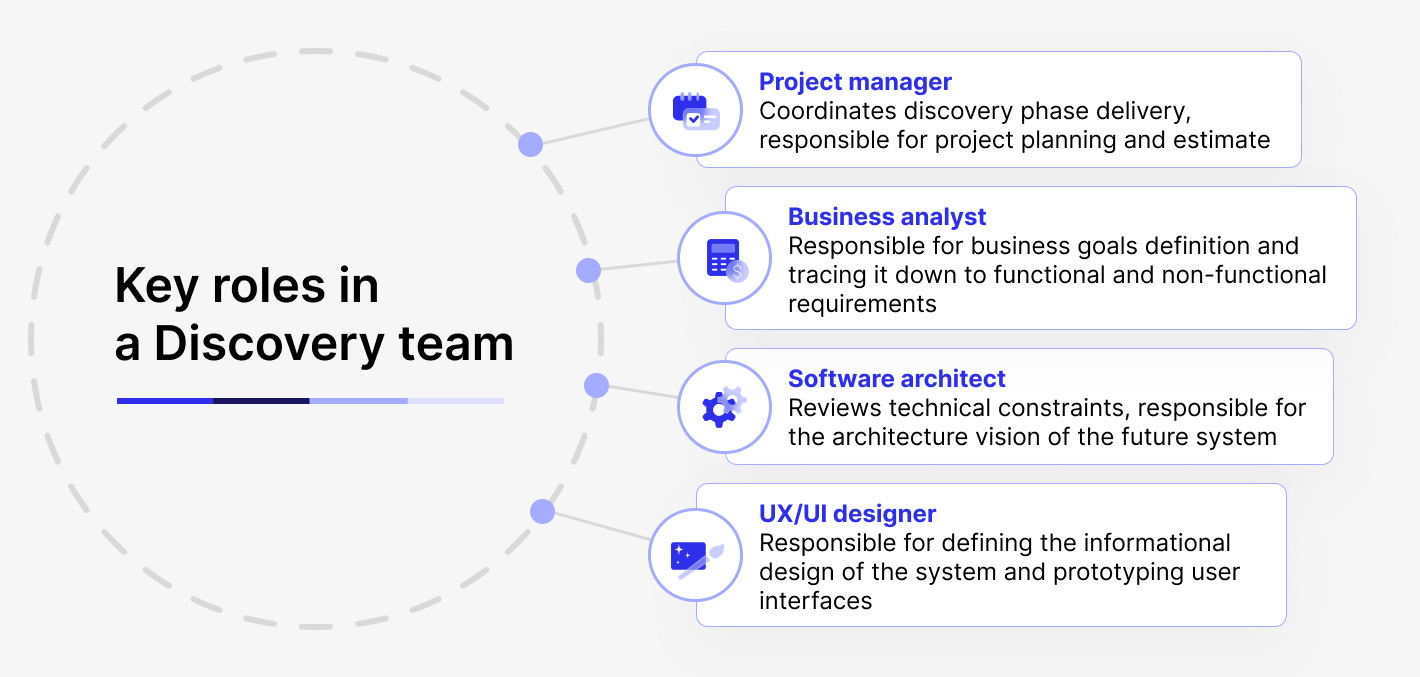
Key roles in a discovery team
You receive a proposal for further activity at the end of the discovery phase. For example, a client reached out to us with a request to conduct a discovery phase for connecting an existing call-tracking product with an external CRM system. We delivered the outputs, including an MVP proposal, that enabled our client to proceed to MVP development.
Prototype development
A prototype is the final product’s preliminary model that simulates its key features. Prototyping allows you to test the product’s viability without resorting to time-consuming and resource-intensive product development.
Prototyping can involve creating feasibility, low-fidelity, high-fidelity, and live data prototypes, depending on the software development life cycle stage. The software team structure for prototyping is typically similar to that of the discovery phase:
- Business analyst
- Product owner
- Project manager
- UX designer
- Software architect
Minimum viable product (MVP) development
A minimum viable product is the version of the product that contains only a few key features that suffice for the early product launch. The software development team can improve the product based on early user feedback.
At this stage, the product development team structure typically includes:
- Product owner
- Project manager
- Business analyst
- UI/UX designer
- Software engineers
- QA specialists
The software engineering team size typically depends on the MVP’s complexity and deadlines.
Need a software development team to turn your product vision into an MVP – or a product team to zero in on the project scope? Contact us to discuss how our team of experts can help you navigate product team structures during the discovery, prototyping, or MVP development.
5 best practices for effective software development team structure
Choosing the appropriate team structure in software engineering and product development is only half the journey in ensuring the development process efficiency. You need to provide software engineering teams with ownership, accountability, and a balanced composition to enable them to perform their jobs effectively.
Here are five best practices for building a software development team that delivers.
Choose the team structure relevant to your project
While it’s not the only crucial decision, selecting the appropriate software engineering team structure for your project matters. Refer to our section on generalist, specialist, and hybrid software development team structures above to make the right choice.
You should consider that the development methodology you select has an impact on the composition and size of the team. For example, in addition to developer roles and responsibilities in agile, you may need a scrum master if you follow the scrum framework.
Split big teams into smaller ones
While the team size depends on the particularities of your project, smaller teams always work more efficiently. So, if your application development organizational structure spans more than 15 people (nine for agile teams), break down the development team roles and responsibilities into smaller teams.
For example, if your agile project requires 15 front-end and back-end developers, it’s best to group them into two teams of seven and eight people. Each software team will then need a team lead among its software development team roles.
Empower team ownership
Ownership is a mindset. Adopting this mindset means each member of the development team feels responsible for the project’s success – and they’re ready to make decisions to ensure the best outcomes possible.
The ownership mindset isn’t compatible with a top-down, strictly hierarchical team structure in software engineering. To build it, you need to foster trust within the software development team, keep team members updated on the project status, and share responsibility.
Hold the software development team accountable
While the ownership mindset implies internal accountability, it’s still best to have specific guardrails to make accountability explicit when managing development teams. It starts with defining product team roles and responsibilities and, therefore, identifying what each person is accountable for.
The app development team should track specific metrics to define its performance. However, keep in mind that all metrics can be gamed, so choose them based on whether how they’re gamed is desirable or not.
Keep your software engineering team structure balanced
When building a software development team, you’re very likely to need both senior and junior/mid-level developers in your software development team structure.
Senior developers (5+ years of experience) have a deep understanding of software architecture and can take on software development management within the team. Junior (<2 years of experience) and mid-level (2-4 years of experience) developer roles in a software development team are typically responsible for developing features and fixing bugs.
Final thoughts
Choosing the right application development organizational structure is the cornerstone of successful software development. A suitable software development team structure should correspond to your time and budget constraints and be in line with the project’s complexity and methodology.
Before you build a software development team, decide on the project scope and vision. The discovery phase will help you do that. During the development, make sure your software development team management approach fosters the ownership mindset and holds the team accountable. You will also need to keep your team balanced in terms of experience.
Need a development partner that smoothly navigates challenges and anticipates risks? Contact us to hire a dedicated software development team composed to fit your product’s unique requirements like a glove.