
Your IT Budget Isn’t the Problem: 5 Hidden Costs of Legacy Applications

Mykhailo Voitovych
Mykhailo Voitovych Linkedin
Head of Engineering
Date published: January 30, 2026

Enterprise IT audits reveal a recurring pattern: organizations tightly control visible IT spend while quietly losing millions each year to inefficiencies embedded in legacy applications. These losses rarely appear as a single line item. Instead, they accumulate across maintenance overhead, security exposure, delivery delays, and missed revenue opportunities.

TL;DR: Legacy systems inflate operating costs, increase risk, and slow growth. Application modernization strategy has become a financial and business necessity.
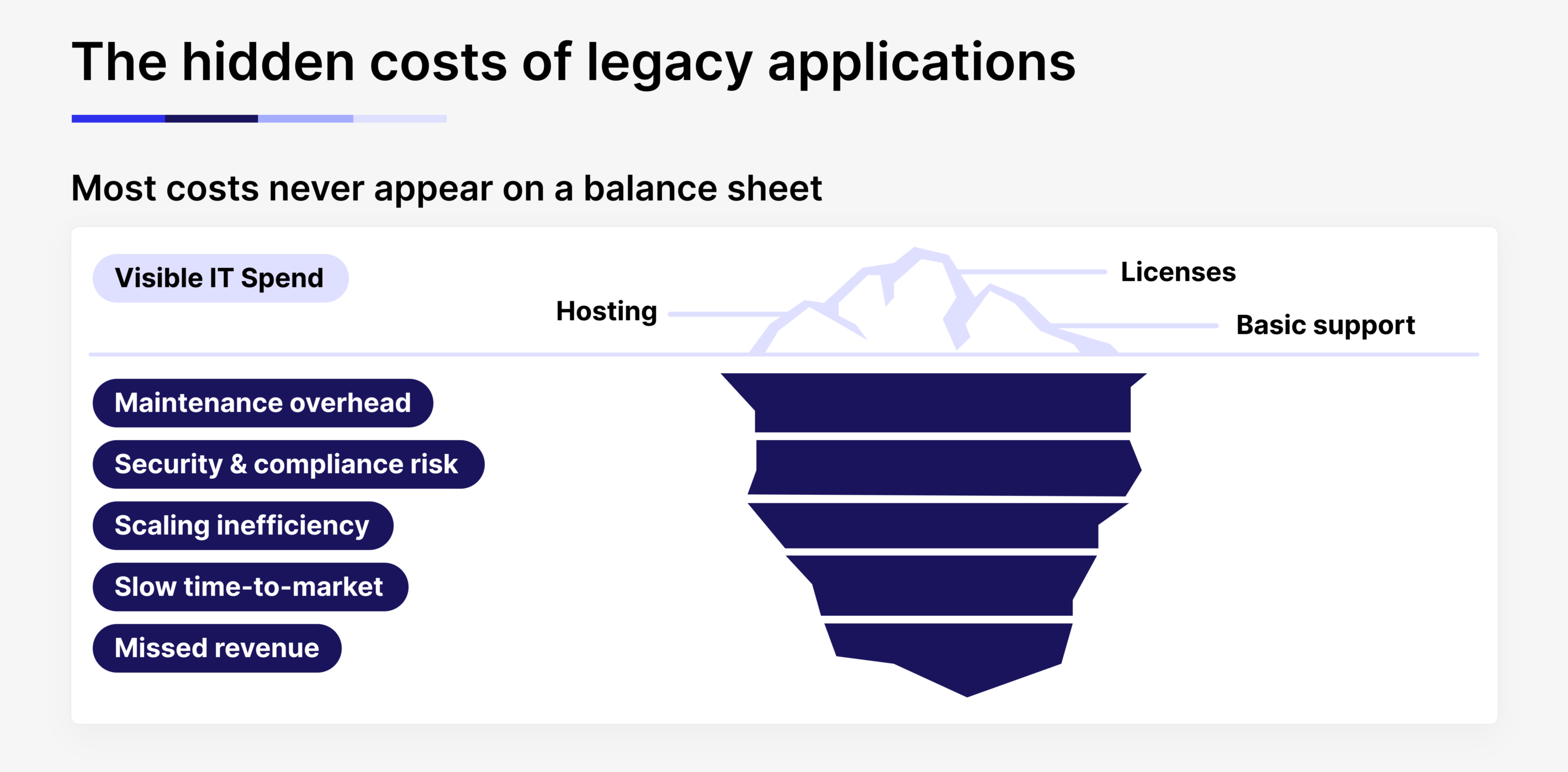
An iceberg illustration showing the visible and invisible spendings in legacy apps

Legacy applications often require three to four times more maintenance effort than modern platforms, diverting engineering capacity away from innovation. What were once strategic investments are increasingly transformed into rigid cost centers, unable to support cloud scalability, AI adoption, or faster go-to-market cycles.

Gartner projects that by 2027, more than 70% of ERP initiatives will fail to fully deliver their business case, with one in four failing outright. This trend affects enterprises and mid-sized companies alike, underscoring the urgent need to modernize ERP systems, core platforms, and customer-facing applications. Now is the time to evaluate your current systems and take proactive steps to future-proof your technology landscape.

For business executives, the real danger lies in compounding inefficiency. Maintenance overhead, security and compliance gaps, integration friction, and opportunity cost escalate year over year. A system that costs $2.4M in its first year can exceed $3.5M annually within five years, driven by accelerating technical debt, without delivering additional business value.
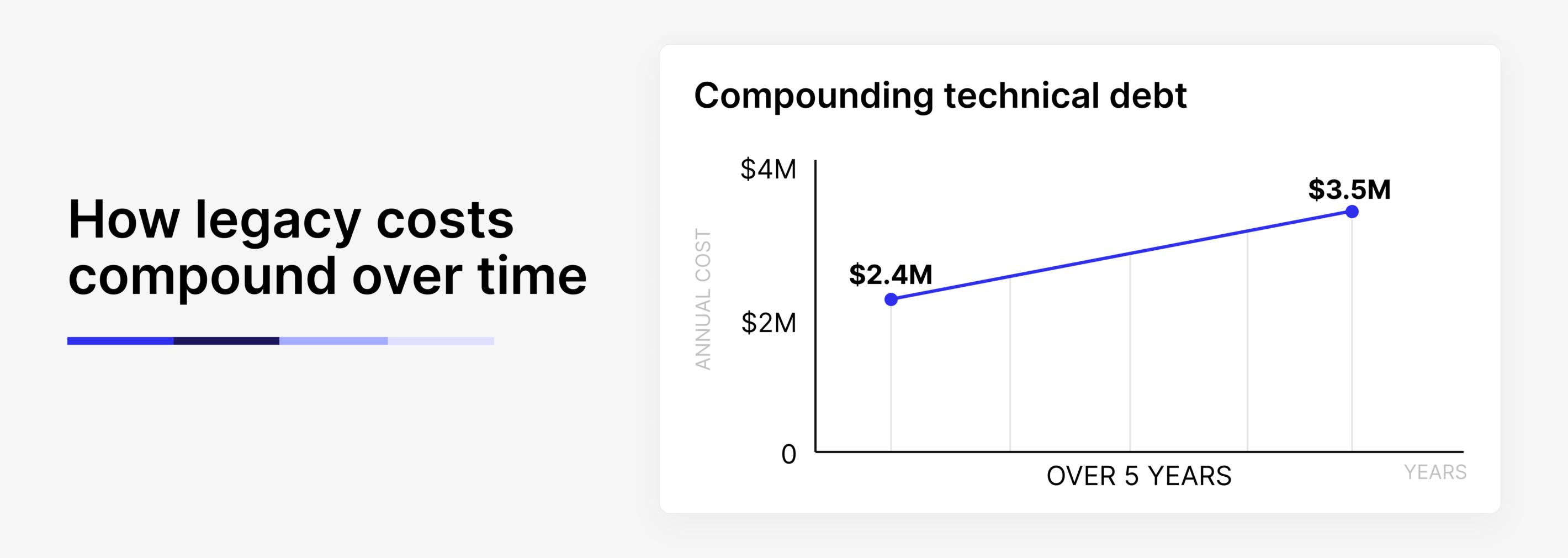
A chart showing accumulation of hidden costs in legacy apps

In this article, we break down where these hidden costs originate, how to identify systems that are actively draining budget and velocity, and how modernization delivers measurable ROI without disrupting business continuity.
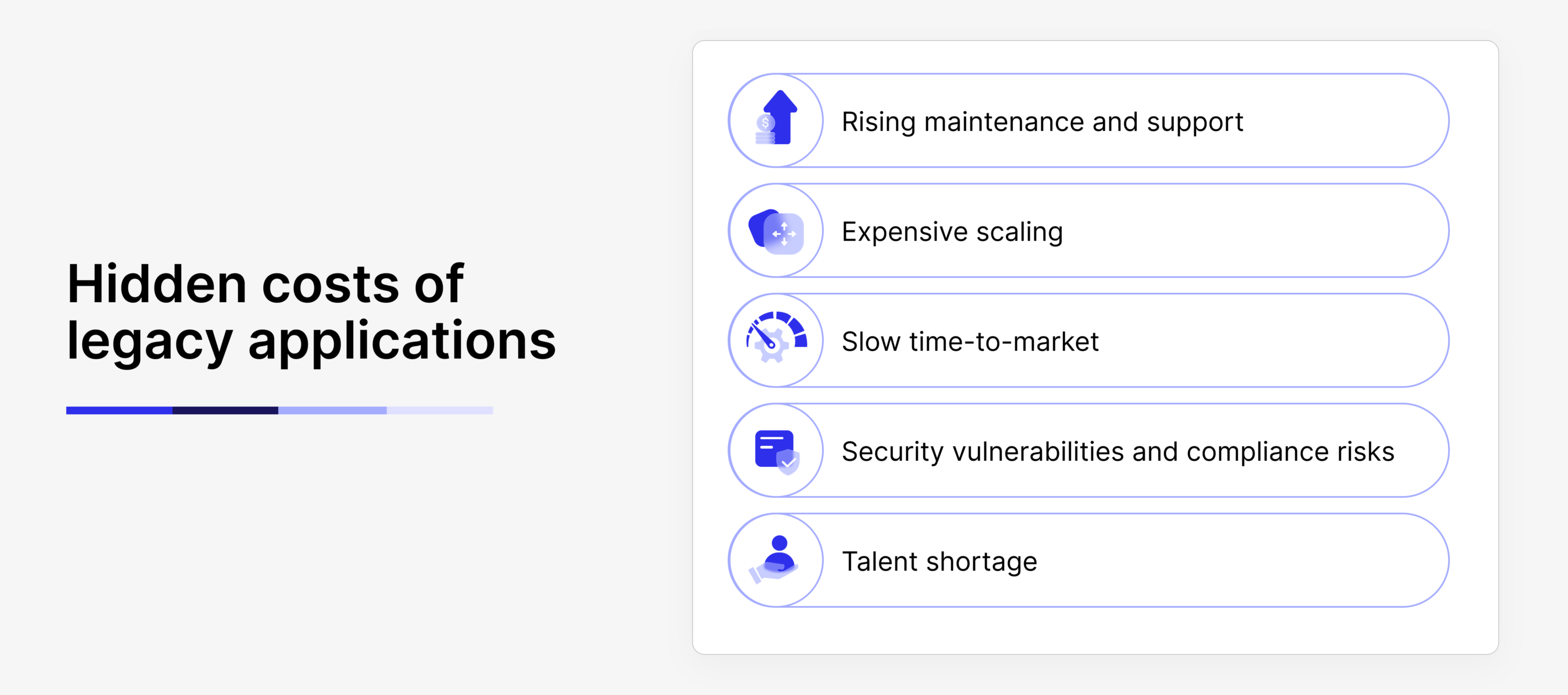
a list of hidden costs in leagacy apps

Hidden cost #1: exponentially rising maintenance and support 

Aging codebases steadily inflate operating costs while amplifying delivery and reliability risks. Over time, even small changes require disproportionate effort due to structural complexity, niche expertise, and rising defect rates. 

Maintenance effort outpaces business value 

Outdated frameworks, custom logic, and architectures that few engineers fully understand create knowledge concentration risk. This means that only a small group of engineers can safely modify critical components. 

Industry benchmarks indicate that organizations failing to actively manage technical debt may allocate up to 40% of their modernization budgets to unplanned remediation by 2027. 

For business leaders, this translates into higher personnel costs and unpredictable budgets. Scarce legacy skill sets command premiums, onboarding cycles stretch, and delivery forecasts lose accuracy. For tech executives, engineering time shifts from building new capabilities to sustaining aging platforms. In practice, changes that once took days now take weeks, requiring extensive validation to avoid cascading failures. 

Defect rates and regression risk escalate 

Without continuous refactoring or automated testing, every change in a legacy application becomes high-risk. Hidden dependencies, outdated libraries, and undocumented behavior make impact difficult to predict. 

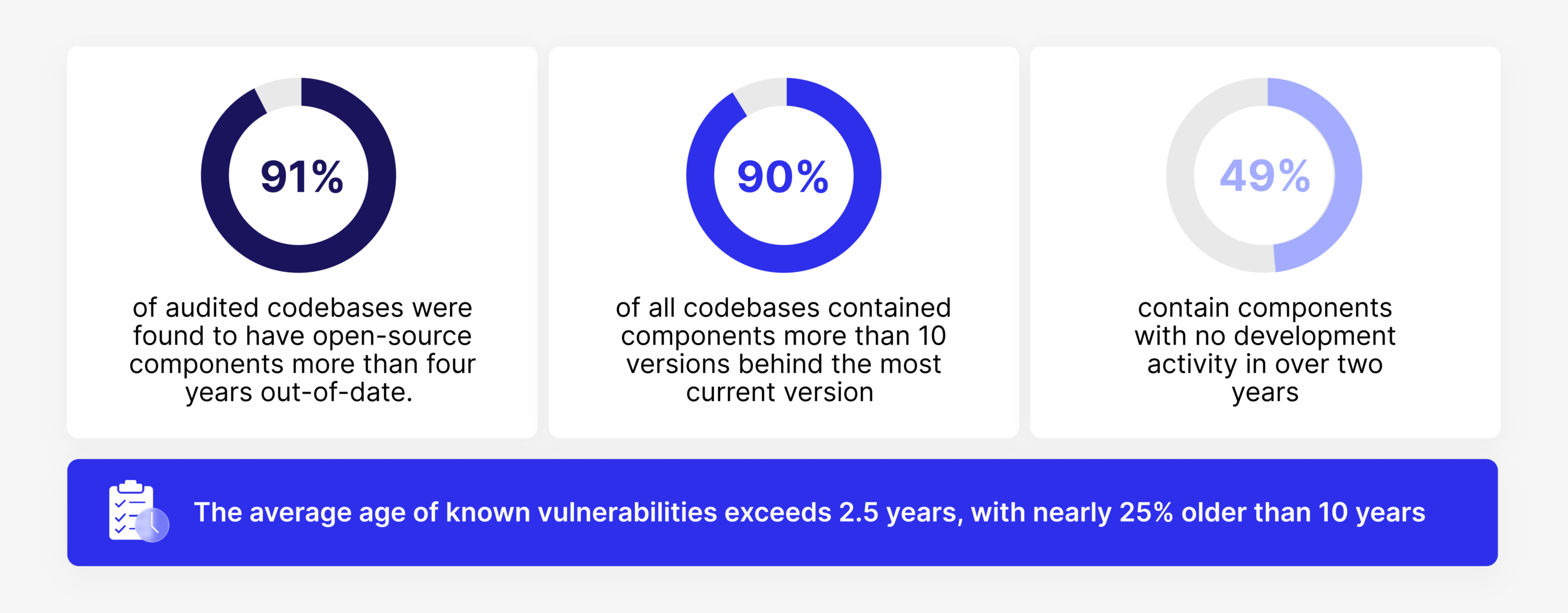
Security report findings turned ito infographics

The 2025 OSSRA report found that: 

  • 91% of audited codebases were found to have open-source components more than four years out-of-date. 
  • 90% of all codebases contained components more than 10 versions behind the most current version 
  • 49% contain components with no development activity in over two years 
  • The average age of known vulnerabilities exceeds 2.5 years, with nearly 25% older than 10 years 

These challenges result in higher defect rates, prolonged incident resolution times, and frequent regressions, all of which contribute to downtime, delayed releases, and increased support costs. In regulated industries such as FS&I, rushed fixes further elevate the risk of audit failures and compliance issues. 

Executive takeaway: When legacy systems’ maintenance cost consumes 70–80% of IT spend, they become a liability. Application modernization becomes a cost containment and risk management strategy.  

Hidden cost #2: scaling becomes expensive, or impossible 

As demand grows, legacy applications struggle to scale efficiently. The issue is architecture. Monolithic and tightly coupled systems force organizations to scale the entire application, even when only a small portion experiences increased load.  

Because monolithic architecture components share resources, data models, and execution paths, teams cannot isolate and scale just that hotspot. Instead, they must replicate the entire application stack. In cloud environments, this means provisioning additional large compute instances; on-premises, it means acquiring new hardware. In both cases, costs rise quickly and inefficiently. 

As a result, infrastructure overprovisioning becomes the default operating model. To avoid performance degradation and outages, teams allocate capacity for peak demand, even if that demand occurs only a few days per year.  

For CFOs, this translates into fixed or semi-fixed infrastructure costs that grow faster than user adoption or revenue. For CIOs and CTOs, it creates constant tension between system stability and cost control. 

The challenge is often compounded by partial modernization efforts. Many organizations “lift and shift” monoliths to the cloud, expecting elasticity to solve scaling issues. In practice, this simply relocates inefficiency. The application still scales as a single unit, now with higher per-hour infrastructure costs and limited optimization options. 

By contrast, modern architectures decouple system components, allowing teams to scale only what is under load. Capacity can be added or released dynamically, aligning infrastructure spend with actual usage.  

A real-world example  

Southwest Airlines relied on its 1990s-era crew scheduling system, SkySolver. By 2018, audits flagged “catastrophic risk,” but modernization was postponed. 

In December 2022, a winter storm exposed the system’s limitations: it couldn’t integrate real-time weather with crew logistics. Over 10 days, 16,700 flights were canceled, stranding 2 million passengers and causing $1.1B in direct losses, with long-term brand damage estimated at $2B.

Recovery took 15 days, and the airline committed $1.3B to modernize IT infrastructure, including cloud-based, scalable, AI-driven systems.

Hidden cost #3: slowed time-to-market (and lost revenue opportunities)

Tightly coupled architectures, accumulating technical debt, and fragile workflows significantly hinder feature development in legacy applications. A single change can have cascading effects throughout the system, necessitating extensive QA cycles, conservative deployments, and prolonged release schedules. This web of dependencies turns even simple updates into time-consuming tasks, ultimately diminishing agility and slowing business response. 

Monolithic systems often lack modularity, automated testing, and reliable CI/CD pipelines. Teams must manually validate changes across interconnected components to avoid regressions. Minor post-release issues can require full rollbacks, further delaying delivery. For businesses, the consequence is lost opportunity: slower experimentation, late feature launches, reduced competitiveness, and revenue. 

Modern architectures decouple functionality into microservices that can be developed, tested, and deployed independently. Automated CI/CD pipelines catch errors early, shortening release cycles from weeks to days. Teams can focus on delivering customer value rather than firefighting infrastructure issues. 

Sombra’s legacy modernization business case 

One of our client’s legacy portals caused order inaccuracies and required support staff to manage errors. Sombra implemented a modernized platform, decoupled architecture, and robust CI/CD processes. The results were dramatic:  

  • SLA improved from 70% to 99.9%  
  • Order corrections became 50× faster 
  • On-time shipping reached 99.5%  
  • Inventory accuracy exceeded 99%  

Slow time-to-market is a revenue and competitiveness risk. Legacy application modernization restores agility, reduces errors, and enables faster, more reliable delivery of customer-facing features. 

Hidden cost #4: security vulnerabilities and compliance risks

Legacy systems create security and compliance liability. As applications age, teams lose the ability to enforce modern security standards, increasing exposure to breaches, regulatory penalties, and long-term reputational damage. 

Security controls that no longer fit 

Many applications were never designed to support today’s baseline security requirements. Architectural constraints often prevent implementation of essentials such as multi-factor authentication, modern identity and access management, encryption, and detailed audit trails.  

Unsupported technology and permanent risk 

A more critical issue is obsolescence. Such apps frequently run on outdated operating systems, frameworks, and dependencies that vendors no longer support. Without security patches or updates, even known vulnerabilities cannot be addressed. 

Interdependencies make upgrades risky or impractical. Fixing one component may require reworking large portions of the system, leaving organizations stuck with unpatchable exposure. These vulnerabilities are often publicly documented, and attackers know exactly where to look. 

Compliance exposure and brand impact 

Regulatory requirements continue to tighten. Frameworks such as GDPR, PCI-DSS, and SOC 2 mandate strict controls over how personal and financial data is stored, processed, and monitored. Organizations are at risk of fines and legal consequences due to their inability to meet these requirements. 

When breaches occur, the damage goes beyond remediation costs. Customer trust erodes quickly, and the perception that a brand is insecure is difficult to reverse. 

Why modernization helps 

Modernization embeds security directly into the software development lifecycle (SDLC). By integrating security as a dedicated stage in CI/CD pipelines, organizations can: 

  1. Enforce baseline security requirements automatically with tools like vulnerability scanners, static/dynamic analysis, and policy enforcement. 
  2. Track and update frameworks, libraries, and dependencies to address end-of-life support issues and known vulnerabilities. 
  3. Align continuously with evolving regulatory compliance standards, ensuring processes, policies, and systems remain audit-ready. 

Hidden cost #5: talent shortage and hiring premiums 

Another hidden but critical cost: difficulty attracting, retaining, and effectively onboarding engineering talent.  

Engineers naturally avoid outdated stacks, leaving organizations with smaller talent pools, longer hiring cycles, and higher salaries. Knowledge gaps amplify onboarding costs, as teams must rely on “tribal knowledge” instead of clear documentation to understand complex, aging systems. 

  • In a Gartner survey, lack of talent availability was cited as a barrier far more frequently than implementation cost (29%) or security risk (7%).  
  • IBM reports that 70% of global business transactions still run on COBOL. 
  • The 2020 U.S. unemployment system crisis highlighted this shortage: COBOL engineers were scarce, and states had to recruit retired programmers to keep systems operational. 

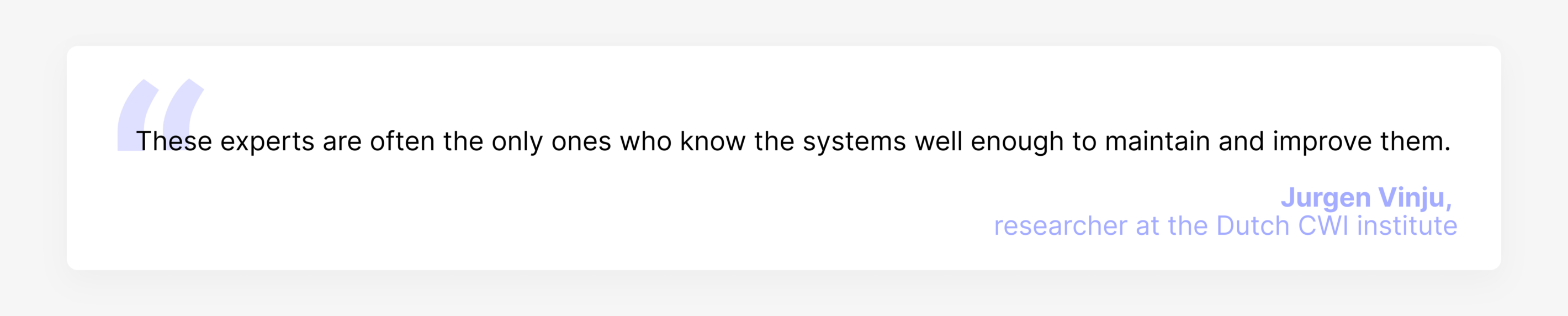
With the retirement of the generation of experts who built these systems, organizations face a severe knowledge gap. As Jurgen Vinju, researcher at the Dutch CWI institute, explains:  

quote

A real-world example  

During the 2020 COVID-19 pandemic, U.S. state unemployment systems, many built in COBOL, couldn’t handle surging claims. States like New Jersey and Connecticut scrambled to find qualified developers, even issuing emergency calls to retired COBOL experts.  

The inability to scale quickly delayed critical financial aid to millions of citizens and drove up operational costs, showing how outdated technology can cripple even mission-critical systems. 

How modernization directly reduces costs  

Modernization provides measurable ROI across infrastructure, maintenance, revenue, security, and talent. 
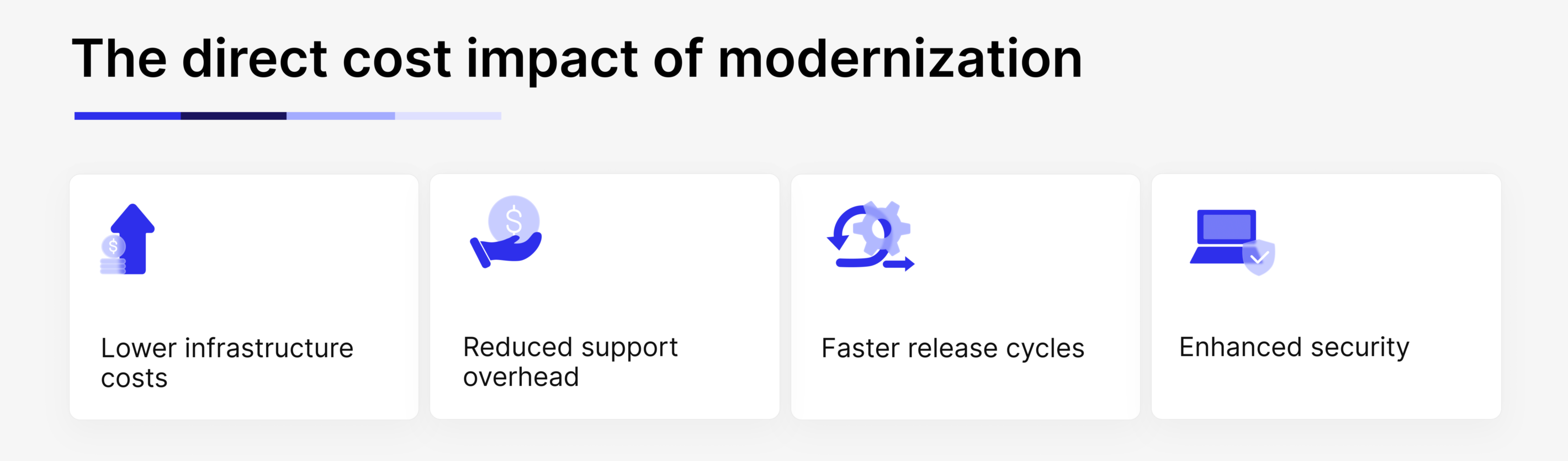
a list of app modernization benefits

Lower infrastructure costs:
Cloud-native optimization eliminates over-provisioning and enables pay-as-you-go scaling. Modernized platforms typically reduce infrastructure costs by 30–35%. For example, Sombra helped a US eClinical technology company modernize its data platform, cutting infrastructure costs by 50% while enabling near real-time data syncing with delays of just 2 minutes. 

Reduced support overhead:
Refactoring, automation, and retiring legacy components lower maintenance and operational costs by 20–40%. Modern systems reduce manual intervention and firefighting, freeing teams to focus on growth initiatives. 

Faster release cycles:
Microservices and CI/CD pipelines accelerate development, shortening time-to-market and reducing opportunity costs. Organizations can respond quickly to customer needs and market changes. 

Enhanced security:
Modern platforms integrate encryption, access control, and policy enforcement, lowering regulatory risk and protecting sensitive data. 

Talent attraction and engineering velocity:
Modern architectures attract skilled engineers, reduce reliance on tribal knowledge, and improve onboarding, lowering hiring premiums and increasing productivity. 

Why modernization pays off even during economic uncertainty

Economic uncertainty turns cost efficiency from a competitive advantage into a necessity. At the core of most large organizations lies aging digital infrastructure that slows innovation and inflates operational risk. In fact, 70% of the software powering Fortune 500 companies was developed more than 20 years ago. Modernizing these systems is complex, but the alternative is unpredictable budgets, reactive firefighting, and mounting technical debt. 

Modern architecture solves these challenges. Cloud-native platforms, microservices, and automated pipelines create predictable costs by reducing manual interventions, maintenance overhead, and system downtime. Tools like agentic AI further accelerate modernization, analyzing workflows, updating infrastructure, and optimizing business processes with minimal human effort, improving efficiency and reducing resource intensity by 40–50%. 

Beyond cost control, modernization delivers flexibility to adapt. Decoupled architectures, scalable cloud solutions, and automated processes allow businesses to respond rapidly to market shifts, regulatory changes, or emerging opportunities. Teams can deploy updates faster, experiment safely, and scale operations without being constrained by legacy limitations. 

Modernization also strengthens operational resilience. Updated systems reduce downtime, enhance security, and integrate seamlessly with evolving technologies, ensuring organizations can maintain service continuity and regulatory compliance even during volatile periods. 

In uncertain economic times, sticking with legacy systems is a gamble. Strategic application modernization transforms aging infrastructure into a predictable, flexible, and secure foundation. 

How to measure “legacy pain” inside your organization 

CTOs can quickly gauge modernization needs with this simple checklist: 

  • Percent of engineering capacity spent on maintenance 
  • MTTR / defect rate trends 
  • Infrastructure costs vs. user growth 
  • Security audit failures 
  • Integration lead time 
  • Developer satisfaction score 
  • Release cycles 
  • Team velocity 

If 3 or more of these indicators apply, the software modernization ROI is immediate. 

How Sombra help companies modernize without disruption

With more than a decade of experience in software engineering and consulting, we’ve worked with plenty of projects across industries, including highly regulated ones, to craft this custom approach: 
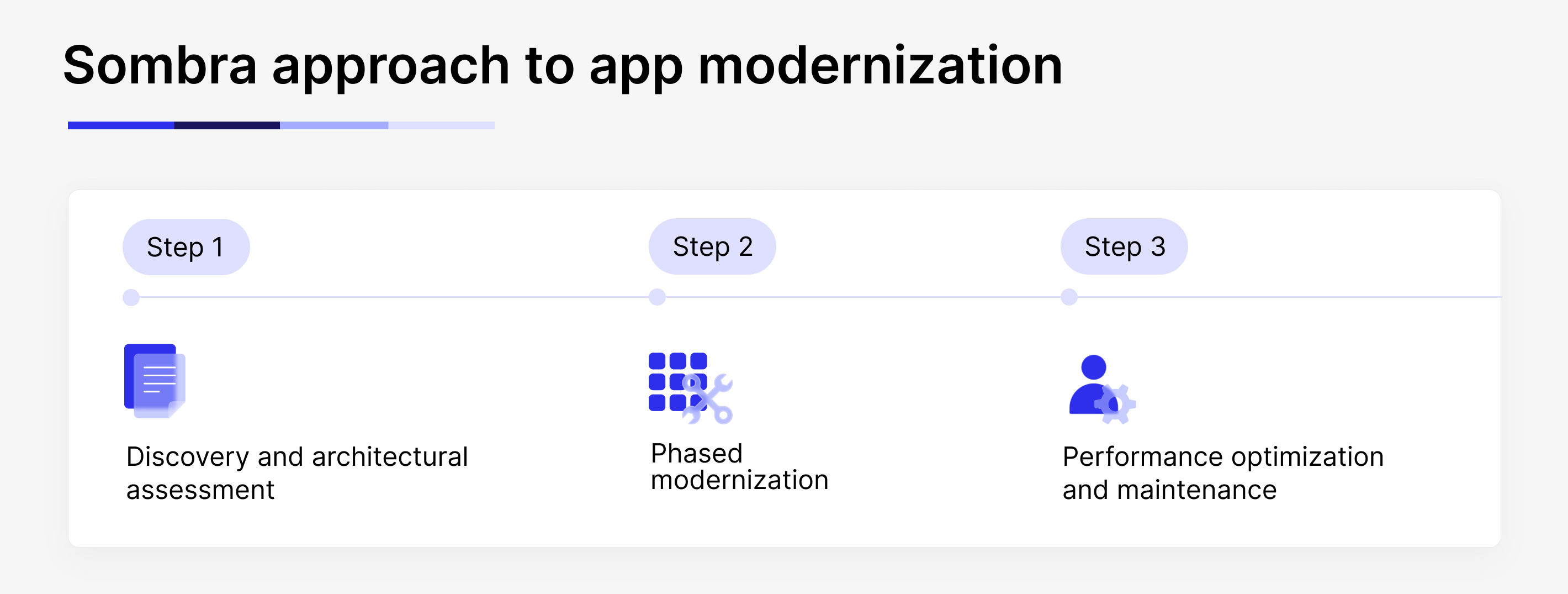
Sombra's 3-step approach to custom app modernization

Our top experts: engineers, architects, and QAs work alongside your internal teams for maximum value. 

The main business challenges we can help you with: 

  • Encountering long time-to-market for an app 
  • Struggling with time-consuming feature implementation or bug fixing 
  • Managing legacy systems and technical debt inefficiently 
  • Neglecting poor user experience 
  • Tackling performance issues and slow-working app 
  • Experiencing security vulnerabilities 
  • Worrying about high infrastructure costs

Contact us to get your legacy application assessment and detailed action plan to take action on hidden costs. 

Tags:

Ready to turn your vision into reality?

We leverage technology, process, and domain expertise to deliver quality software on time and on budget.

Contact us

Frequently asked questions

Why organizations delay legacy application modernization?

How long does modernization take?

Will modernization disrupt daily operations?

Do we need in-house experts?

Contact us

    Thank you for getting in touch!